
What Is Middle East Culture? A Quick Guide for Curious Travelers
Middle East culture is one of the world’s richest and most diverse cultural traditions, spanning more than 20 countries, hundreds of ethnic groups, and thousands of years of history.
If you want the quick version, here it is:
Key facts about Middle East culture at a glance:
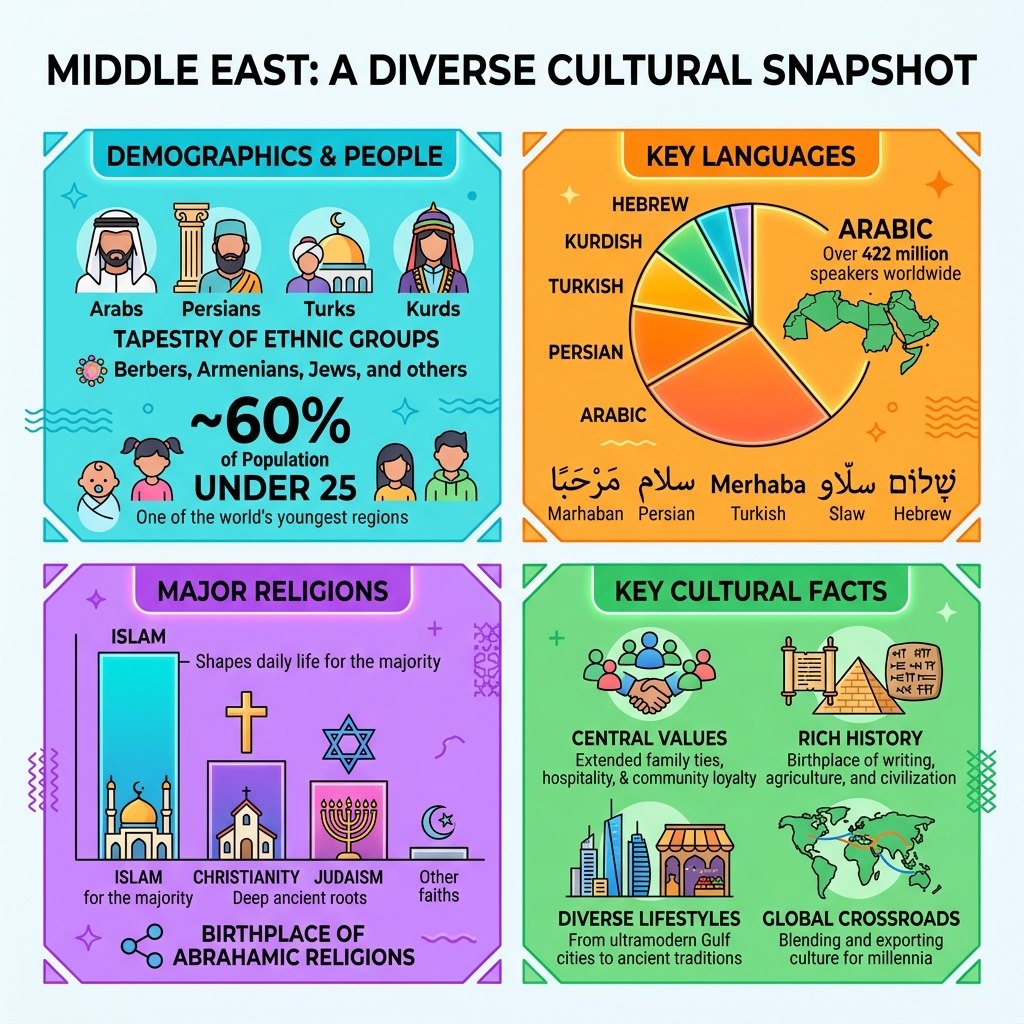
- Language: Arabic is the most widely spoken language, with over 422 million speakers worldwide — but Persian, Turkish, Kurdish, and Hebrew are also major languages in the region
- Religion: Islam shapes daily life for the majority, though Judaism, Christianity, and many other faiths have deep roots here too
- People: The region is home to Arabs, Persians, Turks, Kurds, Berbers, Armenians, Jews, and many more — it is not a single, uniform culture
- Family: Extended family ties, hospitality, and community loyalty are central values across most of the region
- History: The Middle East is the birthplace of writing, agriculture, and all three Abrahamic religions
- Youth: Around 60% of the population is under 25, making it one of the world’s youngest regions
Most people picture deserts, ancient ruins, or news headlines when they think of the Middle East. But that picture misses almost everything interesting.
The region is a crossroads — sitting between Africa, Asia, and Europe — and it has absorbed, blended, and exported cultures for millennia. From the Mesopotamian civilizations that invented the wheel and writing, to the Islamic Golden Age that gave us algebra and modern medicine, to today’s ultramodern Gulf cities, the Middle East has never stood still.
For solo travelers seeking authentic cultural experiences, this region offers something genuinely rare: ancient traditions still alive in everyday life, extraordinary food, stunning architecture, and some of the most welcoming hospitality on earth.
This guide breaks it all down — history, religion, social customs, food, art, and more — so you can explore with confidence and genuine understanding.
The Foundations of Middle East Identity: History and Diversity
To understand Middle East culture, we have to look back at the “Cradle of Civilization.” This region wasn’t just a witness to history; it invented much of it. Following the Neolithic Revolution around 8000 B.C., the Middle East saw the birth of agriculture, the first city-states, and the invention of the wheel and writing.
The History of the Middle East is a saga of overlapping empires—Sumerian, Babylonian, Assyrian, Persian, Byzantine, and Ottoman. Each left a thumbprint on the modern identity of the region. While the term “Arab” originally referred to the nomadic inhabitants of the Arabian Peninsula, the spread of Islam in the 7th century unified vast territories under a shared linguistic and religious banner. However, the region remains a tapestry of distinct lifestyles.
| Lifestyle Type | Key Characteristics | Social Values |
|---|---|---|
| Urban | High-density cities like Cairo or Istanbul | Modernization, education, globalized trade, and arts |
| Rural | Farming villages in the Nile Delta or Levant | Connection to land, traditional agricultural cycles, close-knit community |
| Pastoral Nomadic | Bedouin tribes in the desert | Tribal loyalty, hospitality, independence, and oral poetry |

How Arabic Language Unites Middle East Culture
Arabic is more than just a means of communication; it is the heartbeat of Middle East culture. With over 422 million speakers, it ranks as the fifth most spoken language globally. It exists in three main forms:
- Classical Arabic: The language of the Qur’an and ancient poetry.
- Modern Standard Arabic (MSA): Used in news, government, and formal writing across all 22 Arab League nations.
- Colloquial Dialects: The “street” language that varies wildly from Morocco to Iraq.
Interestingly, while the dialects differ, the written word remains a unifying force. Arabic calligraphy is considered one of the highest forms of art, turning verses of poetry or scripture into intricate visual masterpieces.
Beyond Arabs: The Ethnic Mosaic
One of the biggest misconceptions is that everyone in the Middle East is Arab. In reality, the region is an ethnic mosaic.
- Persians: Primarily in Iran, they speak Farsi and have a distinct artistic and literary heritage.
- Turks: The heirs to the Ottoman Empire, with a unique blend of Central Asian and Mediterranean influences.
- Kurds: Approximately 30 million people living across Iran, Iraq, Syria, and Turkey, maintaining their own language and fierce cultural pride.
- Berbers (Amazigh): The indigenous people of North Africa.
- Mizrahi Jews & Armenians: Groups with ancient roots that have shaped the region’s commerce and history for centuries.
Lebanon alone recognizes 18 official religions, proving that diversity is the rule, not the exception.
The Role of Islam and Social Values in Daily Life
Religion is the lens through which much of Middle East culture is viewed. Between 80% and 90% of people in Arabic-speaking countries identify as Muslim, and the rhythms of Islam dictate the pace of life.
The “Five Pillars”—faith, prayer, almsgiving, fasting, and pilgrimage—are not just religious duties; they are social events. The call to prayer (Adhan) echoes through cities five times a day, and the lunar calendar brings holidays like Ramadan, a month of fasting that culminates in massive community feasts. This Halal lifestyle influences everything from banking to the ingredients in your dinner. For those interested in how these traditions manifest in travel, check out our more info about cultural travel.
Central Family Values and Community Ties
In Middle East culture, the “individual” is secondary to the “family.” Loyalty to the tribe and extended kin is paramount. It’s common to see multi-generational families living in large villas, where the eldest males are respected decision-makers, and mothers are deeply revered.
Hospitality (Karim) is a point of honor. If you are a guest in a Middle Eastern home, expect to be fed until you can barely move. This stems from ancient nomadic roots where welcoming a traveler was a matter of survival in the desert. Today, it remains a core social currency.
Gender Roles and Contemporary Social Changes
The narrative of women in the Middle East is rapidly evolving. While traditional modesty remains important, the “MENA paradox” shows high female university enrollment—often outnumbering men—even if workforce participation lags at around 25%.
However, change is visible:
- In 2023, women held nearly 17% of Arab legislative seats, up from just 3.5% in 2000.
- Tunisia appointed its first female prime minister in 2021.
- Education levels have skyrocketed; students are eight times more likely to attend university today than in 1970.
A Guide to Etiquette, Clothing, and Culinary Traditions
Navigating social interactions in the Middle East requires a bit of “cultural recalibration.” For instance, eye contact is often more prolonged than in the West, signaling honesty and interest. Personal space is also smaller—don’t be surprised if people stand closer to you during a conversation!
Greetings are often warm and physical between members of the same sex, involving handshakes and cheek kisses. However, men and women who are not related often maintain a respectful distance. If you’re a solo traveler craving culture, remembering to use your right hand for eating and greeting is a small gesture that earns big respect.
Traditional Clothing and Modesty Practices
Clothing in the Middle East is a blend of religious requirement, protection from the sun, and cultural pride.
- For Men: The Thawb (a long white robe) and the Keffiyeh (headscarf) are standard in the Gulf. The style of the headscarf—like the Qatari “cobra” fold—can even tell you which country someone is from.
- For Women: Modesty is key, expressed through the Hijab (headscarf), Abaya (black cloak), or Burqa. While laws vary (Iran and Saudi Arabia have different norms than Lebanon or Turkey), many women choose these garments as a badge of cultural identity.
Defining Middle Eastern Cuisine
Food is the ultimate “social glue.” Middle Eastern cuisine is governed by Islamic dietary laws (no pork or alcohol for observant Muslims).
- Mezze: A parade of small dishes like hummus, tabbouleh, and baba ghanoush.
- Mainstays: Flatbreads are used as utensils, and dates are the universal symbol of welcome.
- Drink Culture: Tea is served in small glasses with plenty of sugar, while coffee ceremonies (especially in the Levant and Gulf) are ritualized displays of hospitality.
Exploring Artistic Expressions in Middle East Culture
Art in the Middle East often avoids depictions of people or animals (to avoid idolatry), leading to the development of stunning geometric patterns and “arabesque” designs. The Alhambra in Spain and the Dome of the Rock in Jerusalem are prime examples of this mathematical beauty.
Music and Literature
Middle Eastern music is built on the Maqam system, which uses quarter-tones—notes that fall “between” the keys of a piano. This gives the music its haunting, soulful quality. Instruments like the Oud (ancestor of the guitar) and the Qanun (a flat zither) provide the backing for traditional dances like the Dabke or the celebratory belly dance.
In literature, the region boasts the Mu’allaqat (The Hanging Poems) and the legendary One Thousand and One Nights. These stories of Scheherazade have influenced global storytelling for centuries. To see these influences firsthand, you might enjoy our immersive heritage walks.
Architectural Marvels and Historic Sites
The Middle East is home to over 90 UNESCO World Heritage sites. From the ancient city of Petra to the Umayyad Mosque, the architecture reflects a blend of Byzantine, Persian, and Ottoman styles. In modern times, this has shifted toward record-breaking skyscrapers like the Burj Khalifa, proving the region’s ability to marry the ancient with the futuristic.
Debunking Common Stereotypes About Middle East Culture
It’s time to toss out the “Aladdin” stereotypes. The Middle East isn’t just camels and oil.
- The Urban Reality: Most people live in bustling, tech-savvy cities. Cairo has 16 million residents!
- The Religious Myth: While Islam is dominant, the region is the birthplace of Judaism and Christianity, and these communities still exist and thrive in many areas.
- Globalization: You’ll see young people in jeans with iPhones sitting next to elders in traditional robes. Western influence is present in cinema (Egypt was the “Hollywood of the Middle East”) and media (Al Jazeera).
However, modern life brings modern challenges. The region has some of the world’s highest rates of diabetes and obesity, and rapid urbanization is changing the way people interact with their nomadic roots.
For more insights on where to find these modern-meets-traditional vibes, check out our solo travel destinations for cultural immersion.
Frequently Asked Questions about Middle East Culture
What is the difference between Arab and Muslim?
“Arab” is an ethno-linguistic identity (people who speak Arabic and share Arab culture), while “Muslim” is a follower of the religion of Islam. Most Arabs are Muslim, but the world’s largest Muslim population is actually in Indonesia!
How should travelers dress when visiting the Middle East?
It varies by country, but “modest-chic” is a safe bet. Covering shoulders and knees is respectful in most places. In more conservative areas or mosques, women may need to cover their hair.
Why is hospitality so important in Middle Eastern societies?
It’s a mix of religious duty and tribal tradition. In the desert, refusing a guest was a death sentence. Today, it’s a way to show “Karam” (generosity) and maintain family honor.
Conclusion
Middle East culture is a rich, complex, and deeply rewarding subject to explore. It is a region that respects its elders, cherishes its history, and is currently being reshaped by a massive youth population. Whether you are drinking tea in a Bedouin tent or exploring a contemporary art gallery in Doha, you are participating in a tradition of exchange that is thousands of years old.
At PrimeFinHub, we believe the best way to understand the world is to walk through it. The Middle East offers an unparalleled opportunity for solo travelers to immerse themselves in a culture that is as welcoming as it is ancient.
Discover the best destinations for solo backpackers and start your own Middle Eastern journey today.
