
Why Ancient Sites Independent Exploration Is the Ultimate Solo Travel Experience
Ancient sites independent exploration lets you move at your own pace, linger where you feel drawn, and connect with history without a group pulling you away.
Here are the best ways to explore ancient ruins on your own:
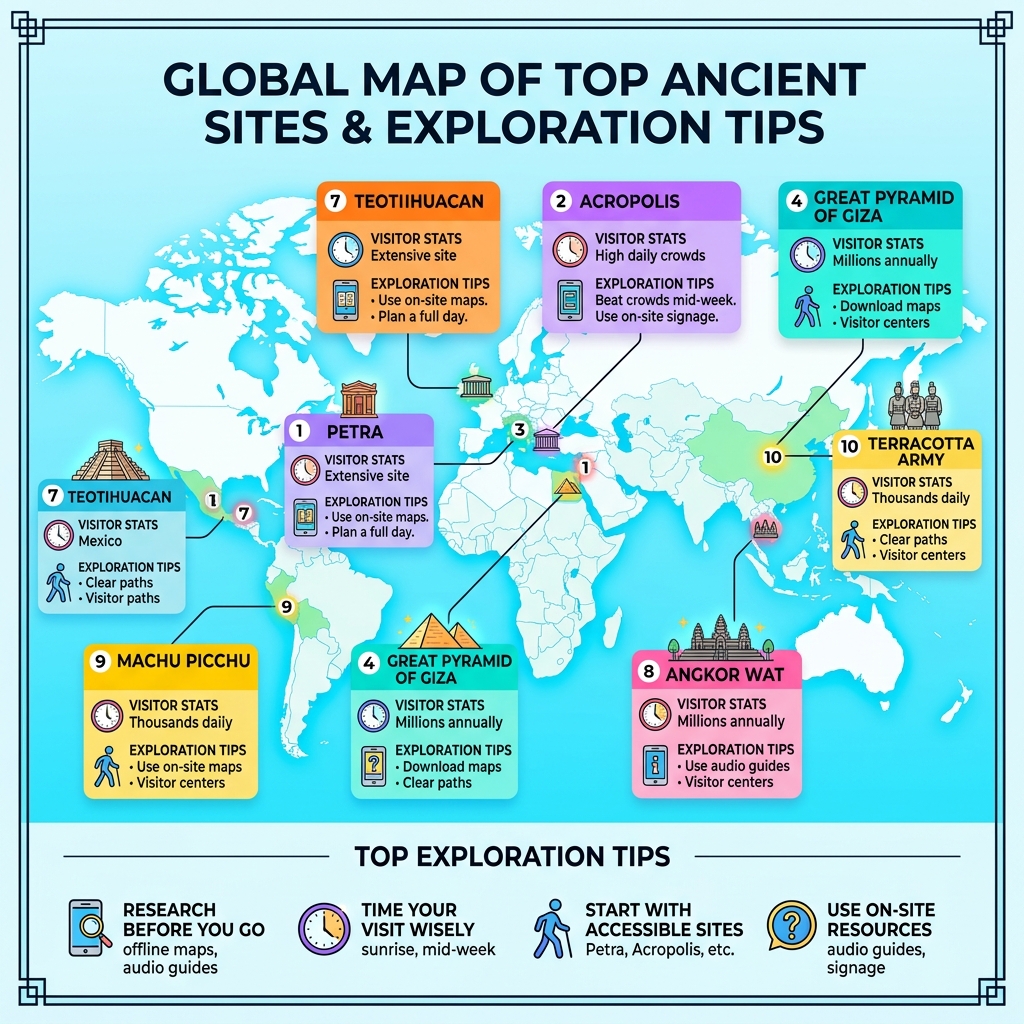
- Research before you go – Download offline maps, audio guides, and PDF site brochures in advance
- Time your visit wisely – Arrive at sunrise or visit mid-week during shoulder season to beat crowds
- Start with accessible sites – Petra, the Acropolis, Pompeii, and Teotihuacan all have clear self-guided paths and visitor centers
- Use on-site resources – Most major ruins offer free or low-cost audio guides and signage
- Know when a local guide helps – Remote or actively excavated sites like Karahan Tepe or Göbekli Tepe benefit from local expertise
The world’s ancient ruins are staggering in scale. The Great Pyramid of Giza was built using 2.3 million stone blocks and originally rose to 482 feet. Angkor Archaeological Park alone stretches across 154 square miles and contains more than 1,000 buildings. The Terracotta Army numbers 8,000 life-size figures. These aren’t just statistics — they’re invitations.
And you don’t need a tour group to answer them.
Solo travelers today have more tools than ever: smartphone apps, downloadable site maps, on-site visitor centers, and thriving communities of independent explorers sharing route advice. The barriers to going it alone are lower than most people think.
The challenge isn’t access — it’s knowing where to start.
This guide covers the best destinations, practical logistics, safety considerations, and free resources to help you explore the ancient world entirely on your own terms.
Top Global Destinations for Ancient Sites Independent Exploration
When we think of ancient sites independent exploration, certain names instantly spark the imagination. These locations are not only historically significant but have developed the infrastructure necessary for a solo traveler to navigate them successfully without a formal tour group.
The Classics: Chichen Itza, Petra, and the Acropolis
In Mexico, Chichen Itza is a masterclass in Maya ingenuity. If you visit during the spring or autumn equinox, you can witness the famous “snake shadow” illusion, where shadows create the appearance of a serpent descending the El Castillo pyramid. To do this independently, we recommend staying in nearby Valladolid and taking an early morning “colectivo” (shared taxi) to arrive before the tour buses from Cancun.
Petra, Jordan’s “Red Rose City,” is another site perfectly suited for the solo wanderer. While the Treasury is the most famous sight, standing 131 feet high, the site is massive. We suggest dedicating at least two full days here. You can walk the main trail independently, but the real magic happens on the high-mountain trails like the one leading to the Monastery, which offers panoramic desert views.
In Athens, the Acropolis remains a beacon of the Greek Empire. Even the most jaded traveler will find themselves in awe of the Parthenon—a marble jigsaw made of some 70,000 pieces. For a safer and more relaxed experience, check out our guide on where to wander safely when you are flying solo to help you navigate bustling historic capitals like Athens.
Jungle Marvels and Sacred Peaks
Angkor Archaeological Park in Cambodia is so vast (400 sq km) that you’ll need a bicycle or a hired tuk-tuk driver to get between temples. The Bayon Temple, with its mysterious smiling stone faces, is a highlight for independent photographers. Similarly, Tikal in Guatemala offers a majestic jungle experience. Climbing Pyramid IV (213 feet tall) provides a view of the rainforest canopy that makes you feel like an explorer from another century.

In Indonesia, Borobudur stands as the world’s largest Buddhist temple. The best way to experience it is at sunrise, watching the light hit the stupas with Mount Merapi in the background. Meanwhile, Machu Picchu in Peru can be reached via the Inca Trail, but independent travelers often prefer taking the train from Cusco to Aguas Calientes and booking their entry tickets months in advance to explore the “Lost City of the Incas” at their own rhythm.
Engineering Wonders: The Great Wall and Beyond
The Great Wall of China stretches over 5,500 miles. While sections like Badaling are crowded, independent explorers often head to Mutianyu for a more peaceful walk. Despite the popular myth, the wall is not visible from space with the naked eye, but its 8-meter height and 6-meter width are plenty impressive from the ground.
Other sites offering rewarding solo experiences include:
- Stonehenge, UK: Recent research suggests some of the bluestones originated in Wales and were moved 150 miles to Salisbury Plain.
- Moai Statues, Easter Island: These massive stone figures actually have bodies buried underground, a fact often missed by casual observers.
- Roman Forum, Italy: While the Colosseum could hold 80,000 spectators and serves as a somber reminder of imperial brutality, the adjacent Forum is where you can truly wander through the heart of ancient Rome.
Planning and Logistics for the Solo Explorer
Successful ancient sites independent exploration requires more than just a plane ticket; it requires a logistical strategy. When you aren’t part of a tour, you are the navigator, the historian, and the safety officer.
Timing and Crowds
The golden rule for solo explorers is to beat the crowds. This usually means arriving at the gate 15 minutes before opening or staying until the final hour before sunset.
| Ancient Site | Peak Hours (Avoid) | Best Time for Solo Visit |
|---|---|---|
| Chichen Itza | 11:00 AM – 3:00 PM | 8:00 AM (Opening) |
| The Colosseum | 10:00 AM – 4:00 PM | 8:30 AM or 1 hour before close |
| Angkor Wat | 9:00 AM – 2:00 PM | 5:30 AM (Sunrise) |
| Petra | 10:00 AM – 3:00 PM | 6:00 AM or 4:00 PM |
Practical Essentials
When packing, think about utility. Sturdy, broken-in walking shoes are non-negotiable—you’ll be walking miles over uneven limestone and dirt paths. A reusable water bottle is essential for sustainability and health, especially in arid climates like Egypt or Jordan.
Safety is paramount when you’re on your own. We recommend reviewing our tips on staying safe while sightseeing alone to ensure you remain aware of your surroundings while lost in the beauty of the past.
Booking and Fees
Entry fees vary wildly. While some sites like the Mikri Doxipara-Zoni tumulus in Greece are currently free, others like Petra can cost around £52 for a day pass. Always check if you need to book in advance. For example, the Ħal Saflieni Hypogeum in Malta, which contains the remains of 7,000 individuals, limits daily visitors and often sells out months ahead.
For those who want to do more than just look, organizations like DigVentures offer “crowdfunded digs.” This allows enthusiasts to join professional archaeologists in excavating Roman villas or Neolithic monuments, turning a vacation into a hands-on contribution to history.
Accessing Remote and Mysterious Ruins
Some of the most rewarding experiences in ancient sites independent exploration come from the places that are hardest to reach. These sites often lack the polished tourism infrastructure of the Great Pyramids, requiring a bit more grit.
Sigiriya in Sri Lanka, also known as Lion Rock, requires climbing 1,200 steps up a 656-foot rock fortress. The panoramic views from the top are worth every drop of sweat. Similarly, Skellig Michael off the coast of Ireland is a jagged island that once housed ascetic monks (and more recently, Luke Skywalker). Accessing it requires a boat permit and a stomach for choppy Atlantic waters, as landings are strictly weather-dependent.
In Northern Greece, the Mikri Doxipara-Zoni tumulus is a fascinating site where you can see ancient wagons and horses buried with their owners. While the site is still being excavated, visitors are welcomed. You can find detailed access to the site through local driving routes from Didymoteichon or Orestiada. For more ideas on low-stress solo destinations, see our guide on where to wander solo without the worry.
Hidden Gems for Ancient Sites Independent Exploration
If you want to escape the “bucket list” crowds, look toward the “cradle of civilization” in Turkey or the remote valleys of Albania.
- Amantia, Albania: This site features a monumental tomb from the 3rd century BC. It’s a 25-minute walk from the village of Ploçe. A word of warning: do not go alone. Not because of people, but because of the rural paths and guard dogs. You can read a detailed account of a visit to the Monumental Tomb at Amantia to prepare for the trek.
- Çatalhöyük, Turkey: Known as one of the oldest cities on Earth (7100–5700 BCE), this Neolithic site was built by a society that lived in communal houses entered through the roof. While you can visit independently, you must be accompanied by a site guard for safety.
- Göbekli Tepe and Karahan Tepe: These sites in Turkey’s Taş Tepeler region are rewriting history. Göbekli Tepe is roughly 12,000 years old—built 7,000 years before Stonehenge by hunter-gatherers. While Göbekli Tepe has a modern visitor center, its sister site, Karahan Tepe, is remote and lacks official signage, making it a true “explorer’s” destination.
- Newgrange, Ireland: Located in the Boyne Valley, this Neolithic passage tomb is older than the pyramids. It is famous for its winter solstice alignment, where a beam of light illuminates the inner chamber for 17 minutes.
For those exploring Asian history, don’t miss our solo traveler’s guide to Asian heritage walks, which covers cultural hubs that blend ancient traditions with modern life.
Safety, Respect, and Preservation on the Trail
The privilege of ancient sites independent exploration comes with a responsibility to the site and the local community. Many of these ruins are fragile; the oils from human hands or the friction of footsteps can cause irreparable damage over centuries.
Responsible Tourism
The motto for any independent explorer should be: “Don’t change the site; let the site change you.”
- Respect Regulations: If a sign says “do not climb,” don’t climb. Even if there isn’t a guard watching, the structural integrity of the stone may be compromised.
- Leave No Trace: Never remove stones or artifacts. Even a small shard of pottery is a piece of the historical record.
- Support Locals: Eat at local tavernas near the sites, hire local transport, and buy authentic crafts. This ensures that the money from tourism benefits the people living near these treasures.
Safety Considerations
When exploring remote ruins like those in the Tektek Mountains of Turkey or the rural hills of Albania, safety concerns shift from pickpockets to nature. Guard dogs in rural areas can be territorial. Always carry a stick or know how to signal you aren’t a threat. Weather is another factor; sites like Pompeii have very little shade, and heat exhaustion is a real risk. We have more detailed advice on staying safe while sightseeing alone that covers everything from health to environmental hazards.
Essential Resources for Ancient Sites Independent Exploration
You don’t need a human guide to have an “expert” experience. Technology has democratized historical knowledge.
- Digital Guides and Maps: Many sites now offer downloadable PDFs. For example, before visiting Çatalhöyük, you can download their site guidebook and map to understand the complex layout of the Neolithic mounds.
- Audio Apps: Apps like Rick Steves’ Audio Europe or site-specific apps for the Colosseum and Acropolis provide high-quality narration for free or a small fee.
- Offline GPS: Use apps like Google Maps (offline mode) or Maps.me. Many remote sites, like the Karahan Tepe enclosures, are not well-signed, so having exact GPS coordinates is a lifesaver.
- Visitor Centers: Never skip the visitor center. They often have 3D models and replica artifacts that provide context you won’t get just by looking at sun-bleached stones.
For more general sightseeing tips, check out our resources on staying safe while sightseeing alone to help you plan your daily itineraries with confidence.
Frequently Asked Questions about Ancient Sites Independent Exploration
What are the best times to visit popular sites to avoid crowds?
The “shoulder seasons”—typically spring (April-May) and autumn (September-October)—offer the best balance of manageable weather and fewer tourists. For daily timing, sunrise is almost always the best option. Not only do you beat the heat and the crowds at places like Chichen Itza or Borobudur, but the “golden hour” lighting is superior for photography.
How can I access remote sites like Skellig Michael without a tour?
While you don’t need a “tour guide” to walk the island, you do need to book a spot on a licensed ferry. These are limited and weather-dependent. We recommend booking at least 3-6 months in advance for summer visits. Once on the island, you are free to climb the 600+ stone steps at your own pace.
Are there low-cost resources for self-guided tours?
Absolutely. Many national museums offer free apps with audio tours. Additionally, community archaeology blogs and open-source maps (like OpenStreetMap) often contain more detail on “off-the-path” ruins than commercial guidebooks. Public transport is also a significant cost-saver; for instance, taking a local bus from Şanlıurfa to Göbekli Tepe costs a fraction of a private taxi.
Conclusion
At PrimeFinHub, we believe that travel is most transformative when it is immersive and self-directed. Ancient sites independent exploration isn’t just about seeing old buildings; it’s about the quiet moment of standing in a 12,000-year-old temple or walking a Roman street and realizing that the people who built them were not so different from us.
By planning carefully, respecting the heritage of the places we visit, and using the wealth of digital resources available, you can unearth history on your own terms. Whether you are climbing the steps of Sigiriya or watching the sun rise over the Boyne Valley, the past is waiting for you to discover it.
Ready to find your next adventure? Explore more unique cultural destinations and start planning your solo journey into history today.
