
The Timeless Appeal of Ancient Ruins Solo Exploration
Ancient ruins solo exploration is one of the most rewarding ways to connect with human history — on your own terms, at your own pace.
Quick answer: Best ancient ruins destinations for solo travelers
| Destination | Why It Stands Out |
|---|---|
| Petra, Jordan | One of the New Seven Wonders of the World |
| Angkor Wat, Cambodia | World’s largest religious monument (402 acres) |
| Karnak Temple, Egypt | Largest open-air religious site on Earth |
| Hampi, India | UNESCO site with unique Islamic-Hindu fusion architecture |
| Volubilis, Morocco | Stunning Roman mosaics, tranquil and uncrowded |
| Ephesus, Turkey | One of the best-preserved ancient cities in Asia Minor |
| Chaco Culture, USA | Remote UNESCO site with 35 kivas and ancient spiritual significance |
There’s something deeply personal about standing where ancient civilizations once thrived — no group schedule, no rushing, no “five minutes per attraction” rule. Just you, the stones, and centuries of history.
Solo travel to historical sites has a unique pull. It encourages self-reflection, sparks genuine curiosity, and often leads to unexpected connections — with locals, fellow history lovers, or simply with yourself.
Whether you’re dreaming of walking through Petra’s rose-red canyons, exploring Angkor Wat at sunrise, or discovering a forgotten Roman ruin in Morocco, this guide covers everything you need to plan a safe, immersive, and deeply rewarding independent trip.
Why Choose Ancient Ruins Solo Exploration?
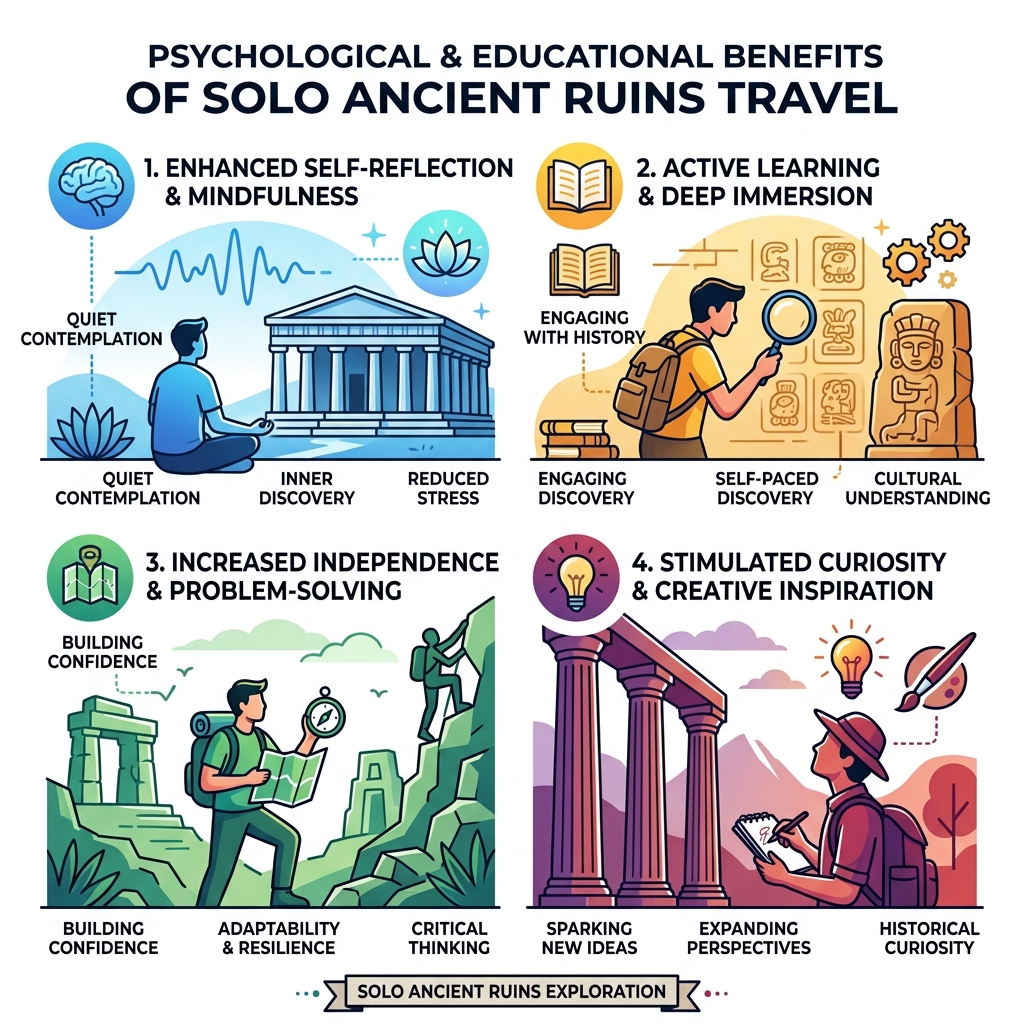
When we think of visiting world-famous landmarks, we often picture a sea of selfie sticks and a guide shouting through a megaphone. However, choosing ancient ruins solo exploration changes the entire rhythm of the journey. For us at PrimeFinHub, the “why” is simple: independence allows the stones to actually speak to you.
Flexible Pacing and Deep Immersion
Have you ever been on a tour where you wanted to spend an hour staring at a single mosaic, but the group moved on after thirty seconds? Solo travel eliminates that frustration. If you want to sit on a fallen column at the Roman Forum and read a book about the Caesars for three hours, you can. This flexible pacing is essential for Mastering Solo Travel: A Beginner’s Guide. It moves you from being a spectator to an explorer.
Personal Epiphany and Meaningful Coincidences
There is a certain “magic” that happens when you travel alone. Without the distraction of a companion, your senses sharpen. You notice the way the light hits a carving at the exact moment the sun sets, or you strike up a conversation with a local caretaker who shows you a hidden inscription. These meaningful coincidences often lead to personal epiphanies—moments where the scale of history puts your own life into a beautiful perspective.
Self-Reliance and Empowerment
Navigating a 900-year-old temple complex or finding your way to a remote desert ruin builds a unique kind of self-reliance. When you successfully navigate the logistics of a site like Angkor Wat or Volubilis on your own, you return home with a profound sense of empowerment. You aren’t just a tourist; you are the architect of your own adventure.
Top Global Destinations for Independent History Buffs

If you are ready to start your journey, several destinations offer the perfect infrastructure for solo travelers while maintaining their ancient soul.
Jordan: The Rock-Cut Wonders
Jordan is a paradise for ancient ruins solo exploration.
- Petra: Named one of the New Seven Wonders of the World, this rock city is vast. Solo travelers can spend days getting lost in its high altars and royal tombs.
- Jerash: Often compared to Pompeii, Jerash features an unbroken chain of human occupation since the Bronze Age (1800 B.C.). It is remarkably well-preserved and easy to navigate independently.
- Amman Citadel: Located in the heart of the capital, this is one of the world’s oldest continuously inhabited places. Don’t miss the massive stone fingers—remnants of a 39-foot Hercules statue.
Egypt: The Land of Giants
Egypt offers some of the most iconic Cultural Travel Destinations for Solo Travelers.
- Karnak Temple: This is the largest open-air religious site in the world. Its Hypostyle Hall covers 50,000 square feet and features 134 massive columns that make even the most confident solo traveler feel small in the best way possible.
- The Great Pyramids: While Giza is famous, did you know Cholula’s Pyramid Tepanapa in Mexico is actually a third larger in volume? Still, nothing beats the solo walk toward the Sphinx at dawn.
Cambodia and India: Spiritual Architecture
- Angkor Wat: Spanning 402 acres, this is the largest religious monument in the world. With a 900-year history, it’s a place where you can easily find a quiet corner for reflection. For more on navigating Asian heritage, check out our Solo Traveler’s Guide to Asian Heritage Walks.
- Hampi, India: The former capital of the Vijayanagar Empire is a surreal landscape of boulders and ruins. It’s famous for its Islamic-Hindu architectural fusion, seen in structures like the Elephant Stables and Lotus Mahal.
Hidden Gems for Ancient Ruins Solo Exploration
Sometimes the best experiences are found away from the crowds.
- Aizanoi, Turkey: If you want to “play Indiana Jones,” this is the spot. It features the only known stadium and theatre combination in the ancient world and remains largely unvisited.
- Volubilis, Morocco: A UNESCO site featuring stunning Roman mosaics that remain in situ. Rain actually enhances their colors, so don’t be afraid of a drizzly day! You can discover ancient roman volubilis through a self-guided walk to see them at your own pace.
- Chaco Culture, USA: Located in remote New Mexico, this UNESCO site was a spiritual hub with 35 kivas. It’s a masterclass in ancient Puebloan engineering.
- Hopewell Ceremonial Earthworks, USA: These ancient mounds align with complex lunar cycles, proving the sophisticated astronomical knowledge of indigenous cultures. This is a great addition if you are planning Solo Travel in South America or North America.
Essential Preparation and Safety for Solo Travelers
Safety is the foundation of a successful solo trip. When we explore ruins, we are often in remote areas with uneven terrain and limited cell service.
Itinerary Sharing and Safety Gadgets
Always inform someone of your daily itinerary before heading into remote sites. Whether you’re hiking to a cliff dwelling or navigating a sprawling temple, someone should know where you are. We recommend checking out Staying Safe While Traveling Alone for more general tips. Additionally, carrying Solo Travel Safety Gadgets, like a satellite messenger or a simple whistle, can provide peace of mind.
Physical Preparation
The physical demands of ancient ruins solo exploration are real. Many archaeological explorations involve walking up to 3 miles a day over uneven stone and dirt.
- Footwear: Sturdy, closed-toe hiking boots are non-negotiable. Flip-flops are a recipe for a twisted ankle on ancient Greek or Roman stones.
- Hydration: Ancient sites are often “heat traps.” Carry more water than you think you need and use electrolyte packets.
Respecting Local Customs
Cultural sensitivity is vital. Many ruins are still considered sacred sites.
- Dress Codes: In places like Hampi or Prambanan, covering shoulders and knees is mandatory.
- Photography: Always check if flash photography or tripods are allowed. In some sites, like the Akrotiri ruins in Greece, you must stay on protective pathways to prevent damage.
- Planning Strategy: For a deep dive into preparation, read our Travel Safety Tips When Going Solo: A Planning Strategy.
Navigating Logistics During Ancient Ruins Solo Exploration
Getting to the ruins is often the hardest part.
- Public Transport vs. Private Drivers: In Turkey, you can take a minibus to sites like Aizanoi, but in Morocco, a private driver from Fez is often more efficient for visiting Volubilis.
- Offline Maps: Download Google Maps or Maps.me for the region before you leave. Ancient sites can be labyrinths where cell signals die.
- Self-Guided Options: If you’re feeling a bit overwhelmed, utilizing a self-guided audio tour for a specific day can offer a nice balance of independence and expert context. This is a great way to See Europe Safely Without a Plus One.
Packing List for Archaeological Adventures
Packing for ancient ruins solo exploration requires a balance between being prepared and staying light. You don’t want to be lugging a heavy pack up the steps of a Mayan pyramid!
| Item | Independent Solo Traveler | Standard Tour Participant |
|---|---|---|
| Footwear | Broken-in hiking boots (essential) | Comfortable walking shoes |
| Navigation | Smartphone with offline maps/GPS | Follow the guide |
| Power | High-capacity portable charger | Standard charger |
| Documentation | Notebook for historical sketches/notes | Provided brochure |
| Photography | Zoom lens for distant carvings | Smartphone camera |
| Hydration | 2L Reusable water bottle + electrolytes | Provided bottled water |
| Sun Protection | Wide-brimmed hat & High SPF | Sunscreen |
Essential Tech and Gear
- Portable Charger: Using GPS and taking hundreds of photos will drain your battery by noon.
- Zoom Lens: Many carvings (like those at the top of Karnak’s columns) are too high to see clearly with the naked eye. A good zoom lens or binoculars are game-changers.
- Breathable Layers: Temperatures can swing wildly between a chilly sunrise at Machu Picchu and a scorching midday sun.
Frequently Asked Questions about Solo Ruin Tours
What is the best time of day to visit ancient sites alone?
The “Golden Hour”—the first hour after sunrise and the last hour before sunset—is the holy grail for solo explorers. Not only is the lighting perfect for photography, but you also avoid the massive tour bus crowds that typically arrive between 10:00 AM and 3:00 PM. Plus, it’s significantly cooler.
How physically demanding are archaeological tours?
Expect to walk at least 3 to 5 miles a day. You won’t just be walking on flat pavement; you’ll be climbing steep, uneven stairs, bouldering over fallen rocks, and navigating dusty paths. If you’re heading to sites like Sacsayhuaman in Peru, the altitude adds another layer of difficulty. We suggest a few weeks of stair-climbing prep before you depart!
Are guided groups better than independent exploration for solo travelers?
It depends on your goals, but for those seeking the ultimate freedom and “personal magic,” independent exploration is unmatched. While some worry about missing historical context, a great solution is using a self-guided audio tour or detailed guidebooks. This allows you to keep your independent pace while still learning the history. If you’re looking for Budget Solo Travel Destinations in Africa, independent exploration allows for a much more tailored and authentic experience.
Conclusion
At PrimeFinHub, we believe that ancient ruins solo exploration is more than just a vacation; it’s a way to reclaim your sense of wonder. By stepping away from the crowd and into the quiet shadows of a temple or the dusty streets of a Roman outpost, you allow history to become a personal conversation.
Whether you are seeking empowerment, spiritual connection, or just the thrill of discovery, the world’s ancient sites are waiting for you. From the lunar alignments of the Hopewell mounds to the towering columns of Luxor, your next great story is written in stone.
Ready to start your journey? Check out our guide on Where to Go When You’re Flying Solo and Craving Culture and Explore Cultural Travel Destinations for Solo Travelers to find your perfect match. Safe travels, explorer!
