
Why European Cultural Road Trips Beat Any Other Way to See the Continent
European cultural road trips are one of the best ways to experience the full depth of Europe’s history, art, and landscapes in a single journey. Whether you follow a structured 21-day tour through 6+ countries or drive your own route along Germany’s Romantic Road, you get something no flight or city break can match: context.
Quick answer — what to expect from a European cultural road trip:
| Feature | Typical Range |
|---|---|
| Duration | 7 days (single country) to 87 days (multi-country) |
| Countries covered | 1 to 8+ |
| Daily walking | 2 to 8 miles on uneven terrain |
| Cost (guided tour) | From ~$7,145 per person + flights |
| Cost (self-drive) | Significantly less, depends on route and pace |
| Best season | May–June or September–October |
The appeal is simple. You move at the pace of the landscape. Buy a croissant on a French beach in the morning, and sip wine beside an Italian lake by sunset. No airport queues between those two moments.
Europe packs more cultural variety per kilometer than almost anywhere else on earth. Ancient Roman ruins sit a few hours’ drive from Alpine villages. Baroque cathedrals give way to Bauhaus architecture. Medieval fairy tale towns border wild Atlantic coastlines.
The hard part isn’t finding things to see — it’s deciding where to start.
That’s what this guide is for. We’ll compare immersive European tours against self-guided road trips, break down real routes, and give you the tools to plan a journey that fits your pace and budget.
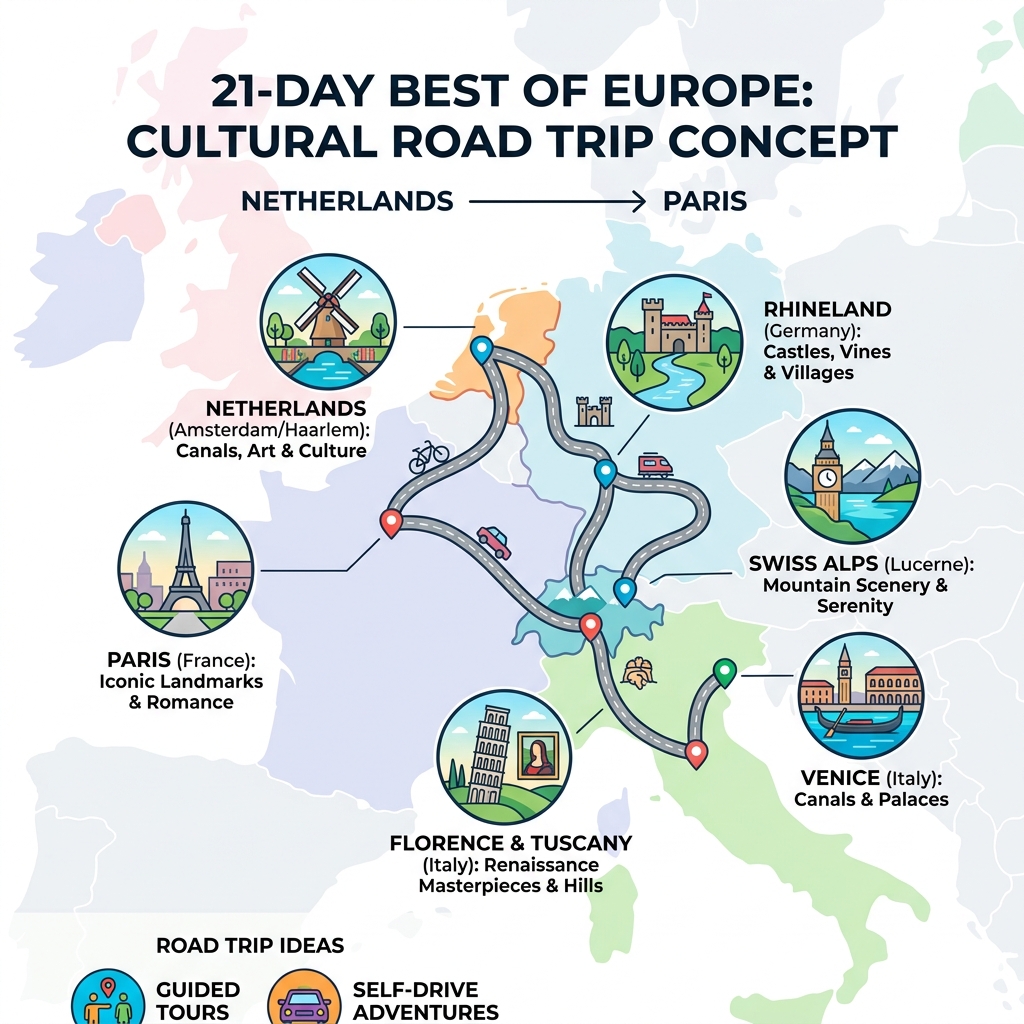
Crafting Your Epic European Cultural Road Trip: A 21-Day Blueprint

When we talk about the “Grand Tour” of the 21st century, we are looking at a multi-country odyssey that connects the dots between the most influential cultural hubs of the West. Designing a 21-day itinerary is an art form. It requires balancing the high-octane energy of Renaissance cities like Florence and Rome with the quiet, restorative beauty of the Swiss Alps or the French countryside.
For those of us traveling independently, a three-week window is the “Goldilocks” duration—long enough to sink into the rhythm of the road, but short enough to keep the momentum alive. We often look at professional itineraries as a masterclass in logistics. For instance, starting in the Netherlands (specifically Haarlem or Amsterdam) allows you to ease into European life before heading south through Germany’s Rhine Valley and the Romantic Road.
One of the biggest questions we hear at PrimeFinHub is whether to join a guided group or go it alone. If you’re wondering how to see Europe safely without a plus one, both options have their merits. A guided tour removes the “mental load” of navigation and hotel bookings, while a self-guided european cultural road trip offers the ultimate freedom to chase a sunset or linger over a second bottle of Chianti.
| Feature | Guided Immersive Tour | Independent Road Trip |
|---|---|---|
| Navigation | Professional driver & guide | You (and Google Maps) |
| Pace | Structured, efficient | Flexible, “go-with-the-flow” |
| Social | Built-in group (usually 24-28 people) | Solo or your chosen companions |
| Deep Dive | Expert local lectures included | Requires self-study/hiring local guides |
| Stress Level | Low (logistics handled) | Moderate (driving/parking/ZTLs) |
Highlights of the Classic 3-Week Sampler
What exactly does a “Best of Europe” route look like? Imagine waking up in the Swiss Alps, specifically the Lauterbrunnen Valley, where 72 waterfalls plunge over limestone cliffs. You might take a cable car to the Schilthorn for a panoramic view of the Eiger, Mönch, and Jungfrau peaks. These are the “wow” moments that stay with you forever.
From the mountains, the road often leads to the Italian coast. The Cinque Terre—five vivid villages perched over the Ligurian Sea—offers a masterclass in coastal resilience and beauty. Here, cultural immersion means hiking the cliffside paths between vineyards or enjoying a cone of fried seafood while watching the fishing boats come in.
Further south, the history becomes ancient. Walking through Rome’s Colosseum or the Forum isn’t just sightseeing; it’s a life-changing humanities course. You move from the Roman ruins to the Renaissance glory of Florence, where the Duomo and the Uffizi Gallery wait. Finally, the journey often loops through the Burgundy region of France—all rolling hills and world-class wine—before concluding in the “City of Light,” Paris, with a sunset cruise on the Seine.
Physical Demands and Immersion
We have to be honest with you: european cultural road trips are not a sedentary vacation. Whether you are on a guided tour or exploring solo, you will be on your feet. Recent data shows that participants on immersive cultural tours walk anywhere from 2 to 8 miles daily. This isn’t just walking on flat pavement; it’s navigating the uneven cobblestones of Rothenburg, climbing the 241 steps to the chapel at San Juan de Gaztelugatxe, or hauling your luggage up a narrow staircase in a centuries-old boutique hotel.
To truly immerse yourself, we recommend choosing centrally located accommodations. Staying in the heart of a medieval town means you can experience the “magic hour” after the day-trippers have left. It allows you to participate in orientation walks led by locals and find those tucked-away bistros that don’t have English menus. If you’re looking for more inspiration, check out our guide on cultural travel destinations for solo travelers 2.
Regional Deep Dives: From Fairy Tales to Atlantic Coasts
If the three-week sampler feels too broad, we love diving deep into specific regions. Germany, for example, is a creative powerhouse that offers several distinct cultural routes. For design lovers, a trip through the “Cultural Capitals” of Frankfurt, Dessau, and Leipzig reveals the roots of the Bauhaus movement. 2026 is actually a massive year for this, with Frankfurt being named the World Design Capital.
But for many, the ultimate German experience is The Romantic Road – The most beautiful travel route in Germany . Established in 1950 to boost post-war tourism, this 460-kilometer route from Würzburg to Füssen is a string of pearls. You’ll visit 29 towns, including Rothenburg ob der Tauber, which is so perfectly preserved it feels like a movie set. The climax of the route is, of course, Neuschwanstein Castle—the 19th-century Romanesque Revival palace that inspired Disney’s Sleeping Beauty castle.
Navigating Northern Spain: A 10-Day European Cultural Road Trip
While the south of Spain gets the most sunshine, the north gets the most “soul.” A Northern Spain Road Trip: 7–10 Day Itinerary, Route and Tips | The Gap Decaders feels like visiting a different country. Here, the Atlantic coastline replaces Mediterranean beaches, and green mountains roll right into the sea.
Starting in Pamplona (famous for the running of the bulls), you can head to Bilbao to see the Guggenheim Museum, a masterpiece of modern architecture that reinvented the city. From there, the road winds through the Picos de Europa National Park—where the highest peak, Torre de Cerredo, reaches 2,650 meters—before ending at the cathedral in Santiago de Compostela. This is the final stop for pilgrims on the Camino de Santiago, and the energy in the Plaza del Obradoiro is palpable. Pro tip: Make sure to try the local cider in Asturias; there’s a specific way to pour it from a height to aerate the bubbles!
The German Fairy Tale Route
For those who grew up with the stories of the Brothers Grimm, the German Fairy Tale Route (Deutsche Märchenstraße) is a 600-kilometer journey into the imagination. Running from Hanau to Bremen, it links over 30 towns associated with the legends we know and love.
You can visit Trendelburg Castle (Rapunzel’s tower), the town of Hameln (of Pied Piper fame), and the “Sleeping Beauty” castle at Sababurg. In Kassel, where the Brothers Grimm lived for over 30 years, you can visit the Grimm World museum, which is part of a UNESCO heritage landscape. This route is especially great for solo travelers who want a bit of whimsy with their history. If you’re craving this kind of magic, take a look at our other cultural travel destinations for solo travelers.
Essential Logistics for Immersive Independent Travel
Driving in Europe is a joy, but it requires preparation. Unlike the wide-open interstates of the US, European roads can be narrow, winding, and full of surprises. If you’re where to go when you’re flying solo and craving culture, a rental car gives you the keys to the kingdom—but watch out for the ZTLs.
ZTL stands for Zona a Traffico Limitato. These are restricted traffic zones in the centers of Italian cities like Florence and Rome. If you drive into one without a permit, a camera will snap your plate, and a hefty fine will be waiting for you when you get home. Our advice? Park on the outskirts of historic centers and walk or use public transport.
Logistics Checklist:
- International Driving Permit (IDP): Often required in addition to your local license.
- Manual vs. Automatic: Most rentals are manual. If you need an automatic, book well in advance and expect to pay more.
- Shoulder Season: Travel in May–June or September–October. The weather is mild, the crowds are thinner, and the prices are lower.
- Tolls: Many countries (like France and Italy) have toll roads. Keep a credit card or small change handy.
Mastering the Art of European Cultural Road Trips Solo
Solo road tripping is one of the most empowering things you can do. It forces you to engage with the world. You aren’t just a passenger; you are the navigator, the DJ, and the explorer.
- Safety First: Share your live location with a friend back home. Use apps like Maps.me for offline navigation in areas with spotty cell service.
- Pack Light: You will be carrying your own bag over cobblestones and up stairs. If you can’t carry it comfortably for 15 minutes, it’s too heavy.
- Flexible Scheduling: Build in “down days.” You can’t see everything. Sometimes the best cultural experience is sitting in a piazza for three hours watching the world go by.
- Language Basics: Learning “Please,” “Thank you,” and “Where is the bathroom?” in the local language goes a long way in building rapport with locals.
Maximizing Your Itinerary: Balancing Structure and Serendipity
The secret to a successful european cultural road trip is the “80/20 rule.” Plan 80% of your logistics—hotels, car rentals, and major museum reservations—but leave 20% for serendipity.
In cities like Paris or Rome, you must book tickets for the Louvre or the Vatican weeks in advance. If you don’t, you’ll spend half your day in a queue. However, don’t over-schedule your afternoons. Leave time to follow the sound of a street musician in Salzburg or to stop at a roadside fruit stand in Sicily.
We also recommend taking “orientation lessons” when you arrive in a new city. Many cities offer free walking tours (where you tip the guide) that give you the lay of the land, a bit of history, and recommendations for where the locals actually eat. This balance of structure and freedom is what makes a trip feel like an adventure rather than a chore.
Frequently Asked Questions about European Road Trips
What are the typical physical demands of a 21-day cultural tour?
Expect to walk between 2 and 8 miles a day. You’ll encounter steep hills, uneven cobblestones, and lots of stairs. You should also be prepared to handle your own luggage, often carrying it up several flights of stairs in older hotels that lack elevators. It’s a “strenuous” level of activity, so we recommend breaking in your walking shoes at least a month before you leave!
How much should I budget for a multi-country European road trip in 2026?
A high-end guided 21-day tour starts around $7,145 per person (excluding airfare). If you are going the independent route, you can manage on a smaller budget, but costs vary wildly by country. For example, Romania and Poland are significantly more affordable than Switzerland or Norway. On average, budget for $150–$250 per day for a comfortable mid-range experience including car rental, gas, boutique hotels, and meals.
What is the best time of year to avoid crowds on popular cultural routes?
The “shoulder seasons” are your best friend. May through June and September through October offer the best balance of good weather and manageable crowd sizes. Avoid July and August if possible; not only is it sweltering in southern Europe, but it’s also when most Europeans take their own vacations, leading to packed sites and higher prices.
Conclusion
Taking the scenic route isn’t just about the miles you cover; it’s about the depth of the connection you make with the places you visit. At PrimeFinHub, we believe that travel should be more than just checking boxes on a bucket list. It should be a transformative experience that challenges your perspectives and enriches your soul.
Whether you are navigating the hairpins of the Grossglockner High-Alpine Road or wandering through the half-timbered houses of a German fairy tale village, remember to slow down. The real magic of european cultural road trips happens in the moments between the landmarks—the unexpected conversation with a baker, the smell of wild thyme on a coastal path, or the quiet awe of a mountain sunrise.
Ready to start your own adventure? Plan your next journey with our curated destination guides and discover the immersive heritage that awaits you on the open road. Safe travels, and as they say in the Netherlands, Goede reis!
