
Why South Africa Culture Is One of the World’s Most Fascinating Melting Pots
South Africa culture is one of the most diverse and layered in the world — a living blend of African, European, and Asian influences shaped by thousands of years of history.
Here is a quick overview of what makes it so unique:
| Cultural Pillar | Key Facts |
|---|---|
| Languages | 11 official languages, including Zulu, Xhosa, Afrikaans, and English |
| Ethnic Groups | Zulu (22.9%), Xhosa (16.5%), Sotho (17.4%), Tswana (7.8%), plus white, Coloured, and Asian communities |
| Religion | Christian (68%), indigenous beliefs (28.5%), Muslim (2%), Hindu (1.5%) |
| Core Value | Ubuntu — “A person is a person through other people” |
| Nickname | The Rainbow Nation |
| Famous For | Braai culture, kwaito music, amapiano, rugby, San rock art, and more |
South Africa is often called the Rainbow Nation — and for good reason. Its population is made up of many different ethnic groups, each carrying their own traditions, languages, and stories. From the ancient San people, who have lived in southern Africa for at least 20,000 years, to the Zulu nation built by the legendary king Shaka in the early 1800s, the country’s cultural roots run extraordinarily deep.
But South Africa is not just about the past. It is a place where old and new collide daily. Township jazz plays alongside global pop. Beadwork and cave paintings exist near modern art galleries. A roadside braai can feel just as meaningful as a fine-dining experience in Cape Town.
For a solo traveler seeking something real — not a packaged version of culture — South Africa delivers on almost every level.
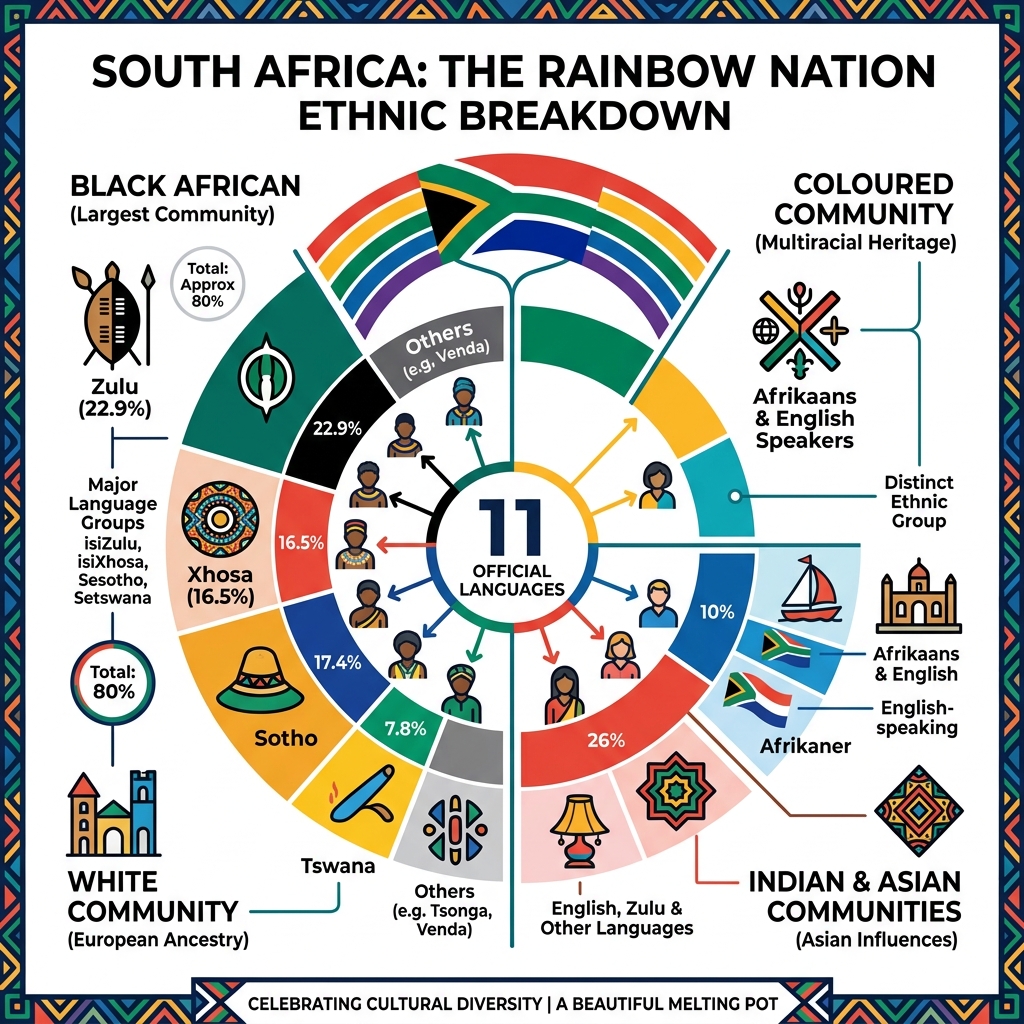
The Pillars of South Africa culture: 11 Languages and One Nation
When we talk about South Africa culture, we have to start with the sheer variety of people who live here. About 80% of the population is comprised of Black Africans, mostly from nine distinct ethnic groups. However, the “Rainbow Nation” also includes significant populations of people with European, Indian, and East Asian heritage, as well as the “Coloured” community—a distinct ethnic group with a complex, multiracial ancestry.
The South African Culture, Customs, and Traditions are deeply rooted in these various identities. The Zulu people are the largest group, making up nearly 23% of the population. They are famous for their history as a warrior nation and their intricate beadwork. Then you have the Xhosa people (about 16%), known for their complex “click” language and rich rites of passage. The Sotho and Tswana groups also make up a large portion of the cultural fabric, each bringing unique styles of village organization and clothing to the mix.

Exploring the Linguistic Roots of South Africa culture
One of the most impressive things about South Africa is its linguistic diversity. For a long time, there were only two official languages, but the 1994 constitution changed everything by establishing 11 official languages to equalize the status of Bantu languages with English and Afrikaans. (Recently, South African Sign Language became the 12th).
While English is the “lingua franca” used in business, government, and media, it is actually only the fourth most common first language. If you are exploring cultural travel destinations for solo travelers, you’ll find that Zulu is the most spoken home language. Afrikaans, which evolved from 17th-century Dutch, is widely spoken across various racial groups and has a rich literary and musical tradition of its own.
In the northern parts of the country, you will hear Pedi (Northern Sotho), Venda, and Tsonga. The Venda culture is particularly fascinating, as it blends influences from East and Central Africa, and their traditions are often centered around sacred sites like Lake Fundudzi.
Ethnic Identities and Traditional Homelands
Despite the pull of modern cities like Johannesburg and Cape Town, many South Africans maintain strong ties to their traditional homelands. The Nguni tribes (which include the Zulu, Xhosa, Ndebele, and Swati) represent about two-thirds of the Black population.
The Ndebele are famous worldwide for their artistic brilliance. Ndebele women are known for painting their homes in incredibly vibrant, geometric patterns and wearing heavy brass neck rings. This is not just for show; it is a vital part of their ethnic identity.
We also cannot forget the San and Khoikhoi people, the original inhabitants of the land. The San, often called “Bushmen,” are legendary for their tracking skills—skills that are still used today in modern anti-poaching efforts. Their ancient rock art, found in caves across the country, is a “storehouse” of prehistoric human history. If you are looking for cultural travel destinations for solo travelers 2, visiting these ancient sites offers a profound connection to the dawn of humanity.
From Apartheid to Ubuntu: Shaping a Modern Identity
You cannot truly understand South Africa culture without acknowledging the shadow of apartheid. This system of institutionalized racial segregation, which lasted from 1948 to 1994, forcibly separated people based on skin color and restricted where they could live, work, and even walk.
The transition to democracy in 1994, led by icons like Nelson Mandela and Desmond Tutu, was a turning point for the world. The Culture of South Africa today is still being reshaped by this history. The Truth and Reconciliation Commission (TRC) was a unique South African invention designed to help the country heal by uncovering the truth about human rights violations rather than just seeking retribution.
Ubuntu: The Heartbeat of South Africa culture
At the center of this healing process is the concept of Ubuntu. It is a word that is hard to translate into English with just one term, but it essentially means “humanity” or “I am because we are.” As Nelson Mandela famously explained, it is the belief that a person is a person through other people.
Ubuntu is not just a philosophical idea; it is a daily practice. It’s about recognizing the humanity in everyone you meet. For us at PrimeFinHub, this is why we recommend South Africa as a where to go when you’re flying solo and craving culture destination. You will find that even in a bustling city, people will take the time to greet you properly. It is never just a transactional “hello”; it is an acknowledgment of your presence.
Communication Styles and Social Etiquette
South African social norms are a blend of traditional African respect and Western directness. Generally, South Africans are very direct and honest in their communication. They appreciate bluntness and often find prolonged silence uncomfortable, so don’t be surprised if a stranger strikes up a conversation to fill the void!
- Respect for Elders: In many Black African communities, respect is shown by using kinship terms. You might call an older woman “Ma” or an older man “Ntate” or “Baba,” even if you aren’t related.
- Eye Contact: While Western culture prizes direct eye contact, in some traditional South African cultures (like in parts of Soweto), children are taught that making direct eye contact with an elder can be seen as a sign of defiance. As a visitor, following the lead of your local guide is always best.
- Greetings: Always start an interaction with a formal greeting. Asking “How are you?” is not just a formality; it is an essential part of the social “check-in.”
- Physical Affection: South Africans are often quite expressive. Physical contact during a conversation—like a pat on the shoulder—is usually a sign of friendliness and trust.
Daily Life and Flavors: Braais, Bobotie, and Social Customs
If there is one thing that unites all South Africans, regardless of race or language, it is the braai. A braai (rhymes with “dry”) is the South African version of a barbecue, but calling it just a “BBQ” is like calling a Ferrari “just a car.”
A braai is a sacred social ritual. It is where families gather, friends debate sports, and communities celebrate. According to South Africa – Diversity, Wildlife, Cuisine | Britannica, the braai is the central element of social life. If you are invited to one, here is a pro-tip: never arrive empty-handed. Bring some drinks or a side dish, and always ask if you should “bring your own meat” (BYO), which is a common practice.
Culinary Traditions and Fusion Dishes
The food here is a delicious “mash-up” of the country’s history. You have traditional African staples like mieliepap (a versatile corn porridge) and umngqusho (a bean and maize dish that was a favorite of Nelson Mandela).
Then you have the Cape Malay influence, which brought spices and fruit into savory dishes. The most famous of these is Bobotie—a spiced minced meat bake with an egg-based topping. It’s essentially the national dish and a must-try for any foodie.
For the adventurous solo traveler, we suggest trying:
- Biltong: Salty, dried meat (similar to jerky but much better, don’t tell the Americans!) made from beef or game like kudu and springbok.
- Bunny Chow: No, it’s not made of rabbits. It’s a hollowed-out loaf of bread filled with spicy curry, originating from the Indian community in Durban.
- Boerewors: A thick, spiced sausage that is the star of every braai.
South Africa is also the third-largest wine producer in the world. The vineyards in Stellenbosch and Franschhoek offer some of the best wine-tasting experiences on the planet. If you are looking for budget solo travel destinations in Africa, you’ll find that high-quality South African wine is surprisingly affordable.
National Holidays and Cultural Significance
Holidays in South Africa are deeply tied to its struggle for freedom.
- Human Rights Day (March 21): Commemorates the Sharpeville Massacre and celebrates the rights of all citizens.
- Freedom Day (April 27): Marks the first non-racial democratic elections in 1994.
- Heritage Day (September 24): Originally “Shaka Day,” it is now a day for all South Africans to celebrate their diverse cultures. Many people call it “National Braai Day.”
- Day of Reconciliation (December 16): A day intended to foster unity between different racial groups.
The Rhythm of the Rainbow Nation: Music and Traditional Arts
Music is the “soul” of South Africa culture. During the apartheid years, music was a powerful tool for protest. Artists like Miriam Makeba (known as “Mama Africa”) and Hugh Masekela used their global platforms to shine a light on the injustices back home.
Today, the music scene is exploding with new genres. Kwaito, which emerged in the 1990s, is a blend of house music and African rhythms. More recently, Amapiano—a hybrid of deep house, jazz, and lounge music—has taken the world by storm.
Traditional Crafts and Ethnic Expression
Visual arts are just as vibrant. From the 75,000-year-old drilled snail shells found in Blombos Cave (the world’s oldest art objects!) to contemporary township art, South Africans have always used art to tell their stories.
Beadwork is a major form of expression, especially for Zulu and Xhosa women. The colors and patterns often carry specific meanings—telling stories of love, status, or grief. In rural areas, you’ll also find incredible textile weaving and pottery that have been passed down through generations.
| Genre | Key Characteristics | Famous Artists |
|---|---|---|
| Mbube | Zulu vocal choral music, often a cappella | Ladysmith Black Mambazo |
| Township Jazz | Fusion of American jazz with local flavors | Hugh Masekela, Abdullah Ibrahim |
| Kwaito | Slow-tempo house music with African lyrics | Brenda Fassie, Arthur Mafokate |
| Amapiano | “The sound of the piano,” deep house/jazz fusion | Kabza De Small, DJ Maphorisa |
| Crossover | Blending Zulu and Western pop | Johnny Clegg (The “White Zulu”) |
Unity Through Sport and the Future of Social Impact
In South Africa, sport is more than just a game; it is a catalyst for national unity. The most famous example is the 1995 Rugby World Cup, where Nelson Mandela wore the Springbok jersey—a former symbol of white supremacy—to show that the team belonged to all South Africans.
Today, the Springboks (rugby), Bafana Bafana (soccer), and the Proteas (cricket) continue to bring the country together. When the Springboks won the Rugby World Cup in 2019 and 2023, the celebrations cut across every racial and economic line in the country.
Business, Social Impact, and Post-Apartheid Progress
While South Africa still faces major challenges—including a high unemployment rate of over 40%—there is an incredible spirit of innovation. In South Africa, social impact isn’t just a “nice-to-have” for businesses; it is foundational.
Many companies are built with the goal of tackling structural poverty. From investment firms targeting small Black-owned businesses to safari lodges that act as job engines for local communities, the business world is deeply intertwined with cultural heritage and social progress. For us at PrimeFinHub, supporting sustainable tourism that gives back to these communities is a core part of what we do.
Frequently Asked Questions about South Africa Culture
What is the meaning of Ubuntu in South African society?
Ubuntu is the belief in a universal bond of sharing that connects all humanity. It translates to “I am because we are.” In daily life, it manifests as hospitality, politeness, and a communal approach to solving problems.
Why is South Africa called the Rainbow Nation?
The term was coined by Archbishop Desmond Tutu to describe the country’s diverse ethnic, racial, and cultural groups coming together after the end of apartheid. It symbolizes hope and the beauty of diversity.
What are the most important social etiquettes for visitors?
Always greet people warmly before asking for help or starting a transaction. If you are invited to a home, bringing a small gift is appreciated. Be open to direct conversation, and show respect to elders by using polite titles.
Conclusion
South Africa is a country that defies easy labels. It is a place of profound contrasts, where ancient traditions live alongside cutting-edge technology. Whether you are listening to the rhythmic clicks of a Xhosa song, sharing a plate of bobotie, or standing in silence at the Apartheid Museum, you are participating in a culture that is constantly evolving and remarkably resilient.
At PrimeFinHub, we believe that the best way to experience a country is to immerse yourself in its heart. South Africa offers a cultural heritage that is as warm as its sun and as deep as its history. For the independent explorer, there is no better place to witness the power of the human spirit.
Ready to start your journey? Explore budget solo travel destinations in Africa and discover the magic of the Rainbow Nation for yourself.
