
The Best Heritage Walks for Solo Travelers in Asia
Heritage walks solo Asia is one of the most rewarding ways to explore the continent — and here are the top routes to know about:
Top Asian Heritage Walks for Solo Travelers:
- George Town, Penang — Shophouse-lined streets, street art, and multicultural temples
- Singapore Chinatown — Colonial history, coolie houses, and hawker culture
- Wan Chai Heritage Trail, Hong Kong — 150+ years of urban evolution across two walkable routes (~3 km)
- Nakasendo Trail, Japan — Edo-period postal road from Magome to Tsumago (8 km day walk)
- Kuala Lumpur Chinatown & Colonial District — Tin-mining history, clan houses, and Merdeka Square
- Kumano Kodo, Japan — Ancient pilgrimage route once walked by emperors
- Sapa, Vietnam — Rice terraces and ethnic minority villages
Asia is extraordinary for solo walkers. The continent holds some of the world’s oldest civilizations, a stunning mix of religions, and centuries of layered history — all compressed into walkable streets, ancient trails, and living heritage neighborhoods.
And the best part? You don’t need a group to experience any of it.
Whether you want to trace the footsteps of Edo-period shoguns on a Japanese mountain trail, explore the opium-den history of Singapore’s Chinatown, or wander Hong Kong’s colonial district past temples and tram lines — Asia has a heritage walk for your pace, your fitness level, and your schedule.
This guide covers the best routes, practical preparation tips, and cultural insights to help you plan your solo adventure with confidence.
Why Choose Asia for Solo Heritage Walking?
Choosing Asia for a walking holiday isn’t just about checking off a bucket list; it’s about a profound sense of personal growth and discovery. For those of us who travel alone, the continent offers a unique blend of safety, accessibility, and deep cultural travel destinations for solo travelers.
One of the primary draws is the sheer density of history. In many Asian cities, you can walk through several centuries in a single afternoon. You might start your morning at a site representing the Indus Valley Civilization and end it in a skyscraper-shadowed colonial district. This architectural evolution tells the story of trade, conquest, and resilience.
Asia is also a place of immense spiritual diversity. Walking these routes allows us to witness a variety of religions and ethnicities living in close proximity. From the incense-heavy air of a Taoist temple to the rhythmic chanting in a Buddhist monastery, these spiritual journeys offer a chance for mindfulness that is hard to find in our frantic daily lives.
Furthermore, the hospitality found across these regions is legendary. Whether you are trekking through the rice terraces of Vietnam or navigating the “five-foot ways” of a Malaysian shophouse, the interaction with locals adds a layer of warmth to the solo experience. You aren’t just a spectator; by walking, you become part of the street-level rhythm of life.
Top Destinations for Heritage Walks Solo Asia
When we talk about heritage walks solo Asia, a few heavy hitters immediately come to mind. These locations are perfectly set up for independent exploration, offering clear signage, safe environments, and stories that practically seep out of the walls.
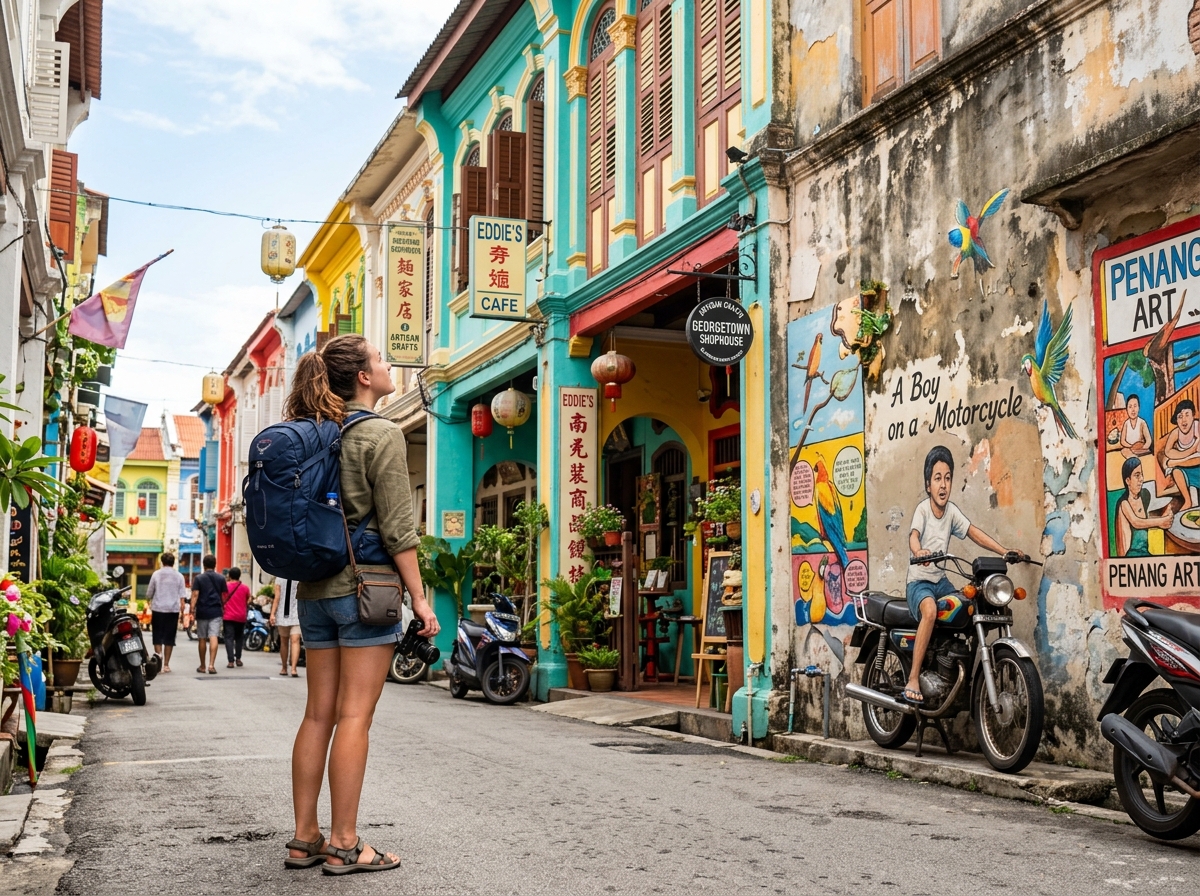
George Town, Malaysia
George Town is perhaps the ultimate “starter” city for heritage walking. As a UNESCO World Heritage site, its core is a living museum. You can spend days wandering through narrow lanes filled with 19th-century shophouses, ornate clan houses (Kongsi), and world-famous street art. It’s a place where you can master solo travel with a beginner’s guide approach because the city is so navigable and the food is so welcoming.
Wan Chai Heritage Trail, Hong Kong
Hong Kong isn’t just about neon lights and finance. The Wan Chai Heritage Trail offers a fascinating look at 150 years of urban evolution. The trail is split into two routes: the Architectural Route (approx. 1.8 km) and the Cultural Route (approx. 910 meters). Highlights include the Blue House Cluster—a brilliant example of community preservation—and the Old Wan Chai Post Office. It’s a compact, high-impact walk that fits perfectly into a busy solo itinerary.
Singapore’s Cultural Districts
Singapore is a goldmine for the solo heritage walker. From the Buddha Tooth Relic Temple in Chinatown to the colorful gopurams of Little India, the city-state offers a masterclass in multiculturalism. The trails here are exceptionally well-maintained, making them some of the most beginner friendly solo travel cities in the world.
Kuala Lumpur, Malaysia
KL’s heritage trail takes you from the bustling markets of Petaling Street to the grand colonial architecture of Merdeka Square. It’s a city of contrasts, where the Sultan Abdul Samad Building stands as a “little stunner” of Moorish design against a backdrop of modern steel.
| Route Type | Best Example | Duration | Difficulty |
|---|---|---|---|
| Urban Heritage | Singapore Chinatown | 2-4 Hours | Easy (Flat) |
| Rural Pilgrimage | Nakasendo Trail | 1 Day | Moderate (Undulating) |
| Mountain Cultural | Sapa, Vietnam | 2-3 Days | Challenging (Inclines) |
| Coastal Historic | George Town | 1-2 Days | Easy (Flat) |
Urban Exploration: From Singapore to Hong Kong
Navigating the dense urban jungles of Asia requires a bit of strategy, but the rewards are immense. In Singapore, the concept of the “five-foot way” is central to the architecture. These covered walkways in front of shophouses were designed to protect pedestrians from the tropical sun and rain—a feature we solo walkers still appreciate today!
While traveling alone in big cities safely, you’ll discover sites like the Buddha Tooth Relic Temple, which, despite looking ancient, was actually built in 2007 for S$75 million. It houses what is believed to be the left canine tooth of the Buddha.
In Hong Kong, the contrast is even sharper. You might find yourself at the Man Mo Temple, built in 1847 to honor the gods of Literature and War. The air inside is thick with giant incense coils, offering a spiritual sanctuary just steps away from the financial district’s glass towers. Walking these cities allows us to see how “Old Victoria” (as Hong Kong was known in 1841) has transformed into a global hub while keeping its soul intact.
Ancient Paths: Heritage Walks Solo Asia on the Nakasendo
If you want to escape the city, the Nakasendo Trail in Japan is a dream for solo adventurers. This was one of the five routes of the Edo period, connecting Kyoto to Edo (modern-day Tokyo). While the full trail is over 500 km, the most popular section for a heritage walks solo Asia experience is the day hike from Magome to Tsumago.
This 8 km (5-mile) walk takes you through beautifully preserved “post towns”—stations where travelers once rested, paid taxes, and swapped horses. Walking through these villages feels like stepping into a woodblock print. You’ll pass traditional Japanese tea houses, water wheels, and stone paths (ishidatami) that have been trodden for centuries.
The trail is well-marked and incredibly safe, featuring “bear bells” along the way that you can ring to alert local wildlife of your presence. It’s a perfect example of cultural preservation, where the modern world feels miles away, even though you’re only a train ride from Nagoya or Tokyo.
Preparing for Your Solo Adventure
A successful solo walk starts long before you lace up your boots. Preparation is the key to moving from “stressed tourist” to “confident explorer.”
Packing and Gear
The golden rule is to pack light. We recommend choosing a backpack with multiple compartments to stay organized. When packing, it is vital to know how to evenly distribute the weight—keep heavier items close to your back and centered to avoid strain.
Essential Gear List:
- Sturdy, lightweight shoes: Never break in new shoes on a heritage walk!
- Performance fabrics: Opt for moisture-wicking layers.
- Navigation tools: Download offline maps (like Google Maps “My Maps” or Maps.me) and bring a power bank.
- Water purification: A water filter bottle is a lifesaver in regions where tap water isn’t potable.
- Local SIM card: Having data is essential for checking transport schedules or translating signs.
Safety Tips for Heritage Walks Solo Asia
Safety is often the biggest concern for solo travelers, but with a few smart habits, you can stay safe while sightseeing alone.
First, always stay safe while traveling alone by sharing your itinerary with someone back home. Whether it’s a friend or your hotel’s front desk, someone should know where you are headed.
Second, respect local cultural etiquette. This is especially important on heritage walks that involve religious sites. In many parts of Asia, you must cover your shoulders and knees to enter temples. Some sites, like the Tiger’s Nest in Bhutan or temples in Bali, are very strict about this. Carrying a lightweight sarong or scarf in your bag is a pro move.
Finally, don’t forget travel insurance. Whether it’s a twisted ankle on a Japanese trail or a lost bag in a crowded market, having that safety net is non-negotiable for the independent traveler.
Gaining Cultural Immersion and Historical Insights
The beauty of a heritage walk is that it forces you to slow down. When you aren’t rushing from one “Instagram spot” to the next in a tour bus, you start to notice the small details: the smell of sandalwood incense, the sound of mahjong tiles clicking in a back alley, or the way the morning light hits a 100-year-old arcade.
For those seeking deep immersion, multi-day treks like the Sapa trails in Vietnam offer a chance to stay in community homestays. Here, you can live with ethnic minority tribes like the Hmong or Dao, learning about their traditions and supporting the local economy directly. These are the hidden gems for solo travelers that provide memories far more lasting than any souvenir.
Historical insights also come from the food. Many heritage walks naturally pass through historic markets or hawker centers. In Singapore, a walk through Chinatown isn’t complete without a stop at the Chinatown Complex, one of the city’s largest hawker centers. In Kuala Lumpur, trying a traditional Hainanese coffee (Kopitiam) tells the story of Chinese migrants who adapted their culinary skills to local tastes.
Frequently Asked Questions about Asian Heritage Walks
What is the best time of year for heritage walks in Asia?
Timing is everything. Generally, the shoulder seasons—spring (March to May) and autumn (September to November)—are best for most of Asia. You’ll avoid the brutal heat of the tropical summer and the heavy rains of the monsoon season. For Japan, spring brings cherry blossoms, while autumn offers stunning foliage on the Nakasendo. For Southeast Asia, the “dry season” (typically November to February) is the most comfortable for long walks.
Do I need a guide for solo heritage walks in Asia?
It depends on the route. For urban walks in Singapore, Hong Kong, or George Town, self-guided routes are perfectly feasible and often preferred for the freedom they offer. However, for more remote or high-altitude treks—like Sapa or parts of the Himalayas—we often recommend considering getting a guide. A guide provides not just safety and navigation, but also deep local context that you might miss on your own.
Are these heritage walks suitable for all fitness levels?
Absolutely. Asia offers everything from flat, 2-hour urban strolls to grueling 10-day mountain treks.
- Beginner: Singapore Chinatown, George Town core, Wan Chai Cultural Route.
- Intermediate: Nakasendo Trail, Tiger’s Nest (Bhutan), Mount Hallasan (South Korea).
- Advanced: Annapurna Circuit (Nepal), Chadar Trek (India). Always check the difficulty grading before you go to ensure the walk matches your physical ability.
Conclusion
At PrimeFinHub, we believe that the most profound travel experiences happen when you step out on your own. By choosing heritage walks solo Asia, you are choosing a path of independent exploration that rewards curiosity with deep cultural connection. From the “ghost lanes” of Kuala Lumpur to the sacred paths of Japan, these routes are waiting to be discovered at your own pace.
Ready to start planning a solo adventure and learn everything you need to know? Dive into our travel planning resources to find more immersive spots tailored for the independent spirit. Your next great story is just a few steps away.
Explore more with PrimeFinHub.
