
Why European Cultural Train Journeys Are the Best Way to Explore the Continent
European cultural train journeys are one of the most rewarding ways to experience Europe’s history, art, and landscapes — all without the stress of airports or constant hotel changes.
Here’s a quick overview of the best options:
| Journey | Route | Highlights | Duration |
|---|---|---|---|
| Spanish Symphony (Al Ándalus) | Seville ↔ Santiago de Compostela | 6 UNESCO sites, flamenco, Moorish Spain | 10 days |
| Glacier Express | Zermatt → St. Moritz | Swiss Alps, glaciers, panoramic views | 1 day |
| Danube Express | Central & Eastern Europe | Prague, Budapest, Transylvania, Balkans | 6–13 nights |
| Venice Simplon-Orient-Express | Paris → Venice | Belle Époque luxury, Italian Riviera | 2+ days |
| West Highland Line | Glasgow → Mallaig | Scottish Highlands, Glenfinnan Viaduct | 1 day |
| Flåm Railway | Flåm → Myrdal | Norwegian fjords, steep mountain scenery | Half day |
Europe’s train network is extraordinary. One day you’re watching the Swiss Alps roll past your window. The next, you’re stepping off onto the cobblestones of a medieval Spanish city.
But planning the right journey — especially as a solo traveler — takes more than just picking a train. You need to know which routes actually deliver on cultural depth, which operators suit independent travelers, and how to book without overpaying or overcomplicating things.
This guide covers all of that. From iconic luxury trains to budget-friendly scenic routes, you’ll find everything you need to plan a trip that feels genuinely immersive — not just a checklist of tourist stops.
Iconic European Cultural Train Journeys and UNESCO Sites
When we talk about european cultural train journeys, we aren’t just talking about getting from point A to point B. We are talking about “rolling palaces” and historic lines that serve as gateways to humanity’s greatest achievements. Europe is home to a dense concentration of UNESCO World Heritage Sites, and many of the most iconic rail routes were specifically designed to showcase them.
Take, for instance, the journey through the heart of Spain. A single rail itinerary can cover over 1,250 kilometers of track, traversing four distinct Spanish regions. Along this path, travelers can encounter up to six UNESCO World Heritage Sites, including the historic centers of Córdoba, Toledo, and Santiago de Compostela. These routes don’t just pass by history; they immerse you in it.
The Swiss Alps offer a different kind of cultural heritage. While the scenery is naturally breathtaking, the engineering of the Rhaetian Railway (which carries the Bernina Express) is itself a UNESCO site. It represents a harmonious blend of technology and nature, crossing high-altitude passes and dramatic stone viaducts that have connected mountain cultures for over a century. Whether it’s the Moorish architecture of Andalusia or the Gothic cathedrals of Northern France, the train offers a front-row seat to the evolution of European design.
Immersive Spanish Symphony and European Cultural Train Journeys
One of the most profound ways to experience Spain is through the “Spanish Symphony” itinerary. This 10-day journey typically utilizes the Al Ándalus, a train that is a destination in its own right. More info on the Al Andalús reveals that its saloon cars date back to 1928–1930, preserving a Belle Époque elegance that makes you feel like you’ve stepped back in time.
As we traverse regions like Andalusia and Castile–La Mancha, the cultural immersion goes deep. In Seville, you aren’t just looking at the Cathedral (the largest Gothic cathedral in the world); you are visiting flamenco museums to understand the soul of the region. The journey often includes stops at traditional haciendas to learn about Pura Raza Española horses and participate in authentic olive oil tastings. For those of us looking for cultural travel destinations for solo travelers, Spain’s rail network provides a safe, structured, yet deeply social environment to explore these traditions.
Central European Heritage on the Danube Express
If your heart is set on the mysterious charm of the East, the Danube Express Luxury Train is the gold standard. This private luxury train specializes in Central and Eastern Europe, linking legendary capitals like Prague and Budapest with hidden gems in the Balkans and Transylvania.
What makes this one of the premier european cultural train journeys is its focus on “unhurried exploration.” Instead of rushing through the countryside, the itinerary builds in expert-led excursions. You might find yourself exploring the medieval castles of Transylvania (perfect for fans of history and Gothic lore) or navigating the complex cultural histories of Sarajevo and Belgrade. These trips often range from 6 to 13 nights, providing enough time to truly digest the architectural shifts from Austro-Hungarian grandeur to Ottoman influence.
Luxury Amenities and Themed Rail Experiences
What happens on the train is just as important as the destinations themselves. Modern luxury rail travel has revived the “Golden Age” of travel, where the journey was a social event.

Onboard amenities are designed to enhance the cultural theme. You can expect:
- Belle Époque Interiors: Polished wood, brass fittings, and plush upholstery that mirror the era of Agatha Christie.
- En-suite Cabins: Many luxury trains now offer Superior Deluxe cabins (some up to 93 sq ft) with full-sized beds and private showers, ensuring you wake up refreshed for a day of sightseeing.
- Gastronomy: Dining cars serve regional specialties paired with local wines. If you are traveling through Hungary, expect Goulash; in Italy, handmade pasta.
- Entertainment: Many luxury routes feature evening musical entertainment, such as a pianist in the lounge car or local folk performers who join for a segment of the trip.
Beyond the “traditional” luxury, there are unique initiatives like the Culture Train programs. Operating routes like Berlin to Wrocław, these trains turn the commute into a festival, featuring on-board readings, concerts, and even language courses. It’s a brilliant way to turn travel time into active cultural exchange.
Seasonal Themes: Christmas Markets and Wine Regions
Timing your trip can completely change the cultural flavor of the journey. Europe’s seasonal rail offerings are legendary:
- Christmas Markets: In late November and December, trains in Switzerland, Germany, and Austria become portals to winter wonderlands. You can hop between the markets of Lucerne and Innsbruck, sipping mulled wine while the train climbs through snowy peaks.
- Wine Regions: The Douro Valley in Portugal is a must-visit for oenophiles. Taking the Linha do Douro from Porto allows you to see the world’s oldest demarcated wine region, with its stunning terraced vineyards, from a vintage rail car.
- The Romantic Rhine: The West Rhine Railway offers a journey through the Rhine Gorge, a UNESCO site packed with more castles per kilometer than anywhere else on earth.
For those of us wondering where to go when you’re flying solo and craving culture, these themed routes provide a natural icebreaker. It is much easier to meet fellow travelers while sharing a glass of Riesling in a dining car than it is on a cramped flight.
Practical Guide to Planning Your Trip
Planning european cultural train journeys requires a balance between structure and spontaneity. You essentially have two choices: an escorted tour or an independent DIY itinerary.
| Feature | Escorted Rail Tour | Independent Itinerary |
|---|---|---|
| Planning | All-inclusive; handled by experts | You book each leg and hotel |
| Guidance | Professional Tour Manager included | Self-guided; requires research |
| Social | Built-in group of 20–35 travelers | Highly flexible; solo-focused |
| Cost | Higher upfront cost | Can be tailored to any budget |
| Luggage | Often includes porterage | You carry your own bags |
When planning, consider the “Panoramic Seats.” On routes like the Glacier Express, these windows wrap into the ceiling, offering views of the Swiss Grand Canyon that you simply cannot see from a standard seat. Also, keep in mind that while most of Europe is accessible, some luxury trains (like the Venice Simplon-Orient-Express) only run specific routes—like Paris to Istanbul—once a year.
For more insights into choosing the right path, check our guide on cultural travel destinations for solo travelers.
How to Book European Cultural Train Journeys Independently
If you prefer the “DIY” approach, booking european cultural train journeys has never been easier, but it does require some “rail-smarts”:
- Rail Passes: The Eurail pass is the gold standard for non-European residents. It allows for flexible travel across 33 countries. However, for high-speed trains (like the TGV in France or AVE in Spain) and night trains, you must book a seat reservation in advance, which carries a small additional fee.
- Regional Passes: Sometimes a country-specific pass is better. The Swiss Travel Pass, for example, covers trains, buses, boats, and even entrance to over 500 museums.
- Booking Platforms: Use official sites like Deutsche Bahn (Germany), Renfe (Spain), or Trenitalia (Italy) for the best prices. Avoid third-party resellers that add heavy commissions.
- Off-Peak Travel: To save money and avoid crowds at cultural sites, travel in the “shoulder seasons”—May, June, September, and October. The weather is mild, and the trains are quieter.
- Upgrades: If you are traveling solo, a First Class upgrade is often worth the extra $20–$40. You get more luggage space, a quieter environment, and often, at-seat meal service.
Sustainable Exploration for Solo Travelers
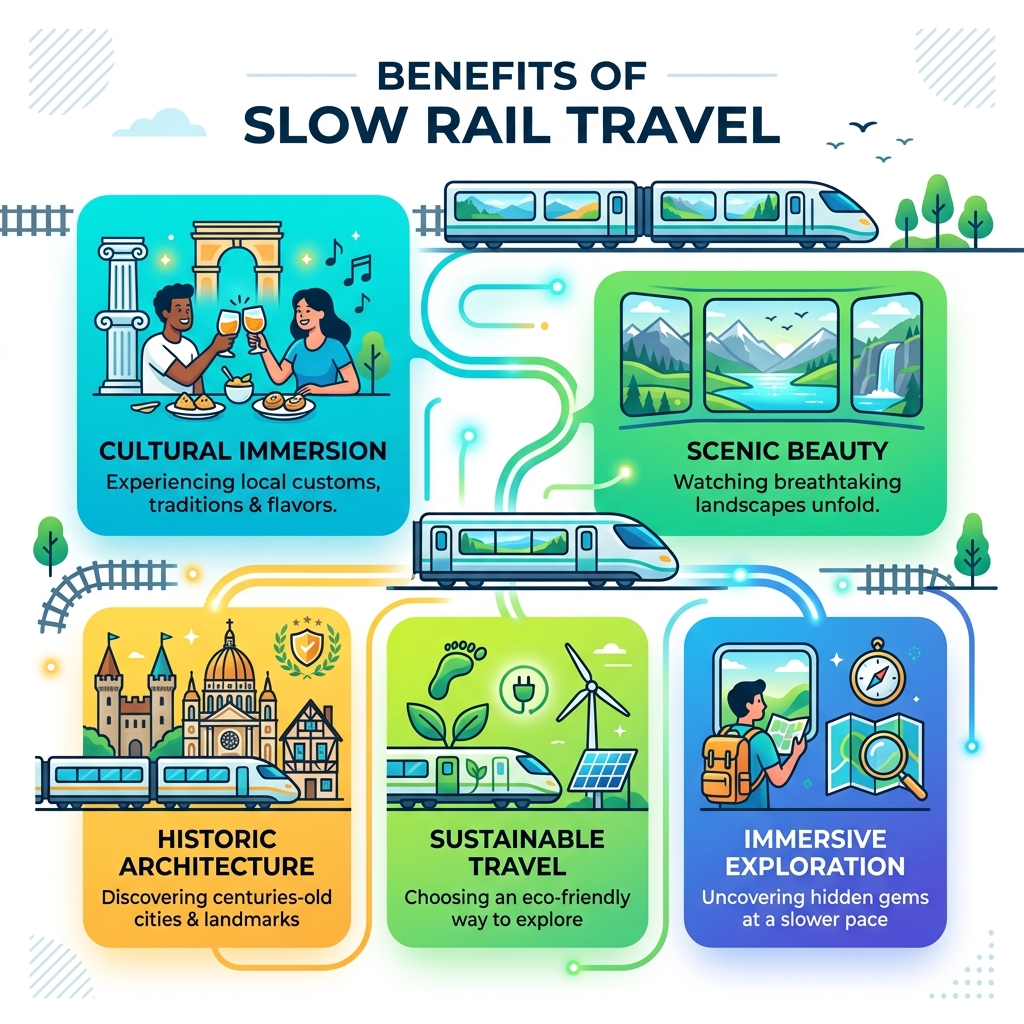
One of the greatest benefits of traveling by rail is its sustainability. In an era where we are all conscious of our carbon footprint, trains represent the most eco-friendly way to see the continent. Initiatives like “Swisstainable” in Switzerland emphasize low-carbon travel, encouraging visitors to use the dense rail network to reach even the most remote alpine villages.
For the solo traveler, trains offer a unique safety net. Most major European stations are centrally located, meaning you step off the train and you are already in the historic heart of the city—no expensive, lonely taxi rides from far-flung airports. If you’re concerned about safety, we have a comprehensive guide on how to see europe safely without a plus-one.
Train travel also promotes “Slow Fashion” and conscious consumption. When you travel by rail, you are more likely to visit local artisan workshops—like the umbrella repair shops in Ljubljana or the youth-led craft projects in Graz—rather than duty-free airport shops. You become a participant in the local economy, helping to preserve the very culture you came to see.
Frequently Asked Questions about European Rail Travel
What is the best time of year for a cultural train trip?
For scenic beauty and comfortable walking tours, May to June and September to October are ideal. If you want a specific cultural experience like Christmas Markets, late November through December is the only time to go. For the “Sun-drenched Mediterranean” feel, July and August are great, but be prepared for high temperatures and larger crowds.
Are luxury train journeys suitable for solo travelers?
Absolutely. In fact, they are often preferred by solo travelers. The social atmosphere in the lounge and dining cars makes it incredibly easy to meet like-minded people. Most luxury operators, like the Danube Express, offer single-occupancy cabins or “single-share” options to keep costs manageable while ensuring a social environment.
How do I book tickets for specific cultural routes?
For luxury private trains, you generally need to book directly through the operator or a specialized rail travel agency. For national scenic routes (like the West Highland Line or the Rhine Valley), you can simply buy a standard ticket through the national rail website. We recommend booking at least 3–6 months in advance for popular luxury routes, as they often sell out.
Conclusion
At PrimeFinHub, we believe that travel should be more than just a change of scenery—it should be a change of perspective. European cultural train journeys offer exactly that. They allow us to slow down, engage with history, and explore the continent in a way that is both sustainable and deeply personal.
Whether you are sipping sherry on the Al Ándalus as it winds through the olive groves of Spain, or watching the sunrise over the Hungarian plains from the window of the Danube Express, the rail experience is unmatched. It provides the structure we need to feel safe and the freedom we crave to explore independently.
Ready to start your journey? Explore our top cultural destinations and find the perfect itinerary for your next solo adventure. The tracks are laid, the whistle is blowing—all that’s left is for you to step on board.
