
Why Cultural Kite Festivals Asia Should Be on Every Solo Traveler’s Bucket List
Cultural kite festivals Asia are some of the most visually stunning and deeply rooted celebrations on earth. Here is a quick look at the top ones:
| Festival | Country | When | Key Feature |
|---|---|---|---|
| Uttarayan (International Kite Festival) | India | January 14-15 | 8-10 million participants; fighter kites |
| Weifang International Kite Festival | China | April 20-25 | 60+ countries; 10,000 kites launched at once |
| Bali Kite Festival | Indonesia | July | Giant 10m kites; Hindu harvest rituals |
| Ikazaki Kite Battle | Japan | May 5 | 500 kites; 400+ year-old battle tradition |
Across Asia, kite flying is far more than a hobby. It is woven into religion, harvest rituals, community identity, and centuries of folklore.
In Gujarat, India, children set their alarms for 5 a.m. on January 14th just to catch the best pre-dawn wind. In Bali, teams of 70 to 80 people spend weeks building and blessing a single giant kite before it ever leaves the ground. In Weifang, China — considered the birthplace of the kite — over 10,000 kites once filled the sky simultaneously.
These are not just festivals. They are living history you can walk into as a solo traveler.
Whether you are drawn to the spiritual, the competitive, or the sheer spectacle, Asia’s kite festivals offer something rare: a chance to connect with local communities around a tradition that goes back thousands of years.
The Historical Roots of Cultural Kite Festivals Asia
To understand why cultural kite festivals Asia are so spectacular today, we have to look back over 2,000 years. Most historians agree that the kite was born in China during the Han Dynasty. Legend tells of General Han Hsin, who used a kite to measure the distance of a tunnel he was digging into a city he was besieging. From these military beginnings, kites soared along the Silk Road, carrying with them stories, spiritual beliefs, and artistic craftsmanship.
In ancient times, kites weren’t just toys; they were tools for signaling and even religious vessels. In many Asian cultures, the wind is seen as a divine force. Flying a kite was a way to communicate with the gods, offer thanks for a bountiful harvest, or ward off evil spirits. The traditional construction—using split bamboo for the “bones” and silk or handmade paper for the “skin”—remains a respected art form today.
As these traditions evolved, cities like Weifang became global hubs for the craft. The Weifang International Kite Festival celebrates this heritage, where the transition from military signaling to artistic expression is on full display. Whether it’s the symbolic dragon representing power and luck or the simple rhombus-shaped fighter kite, every design tells a story of human ingenuity and our ancient desire to touch the sky.
Top Destinations for Immersive Cultural Kite Festivals in Asia
For the solo traveler, these festivals provide a ready-made community. You aren’t just a spectator; you are part of a city-wide transformation. We have found that the most immersive experiences happen when the entire local economy and social life revolve around the event for a few days.
Ahmedabad, Gujarat: The Heart of Uttarayan
The International Kite Festival in Ahmedabad, also known as Uttarayan, is perhaps the most intense kite experience on the planet. Marking the sun’s transition into the zodiac sign of Capricorn (Makar Sankranti), it signals the end of winter.
If you visit for the Kite Festival 2026, expect to see approximately 8 to 10 million people participating across the state. The Sabarmati Riverfront alone can hold over 500,000 spectators! The air is filled with the shouts of “Kai Po Che!” (I have cut the kite!) as flyers engage in fierce battles using manja—a string coated in crushed glass and glue designed to slice through a rival’s line.
Don’t miss the Patang Bazaar, which stays open 24 hours a day during the festival week. For foodies, the festival is a dream; you’ll find locals sharing undhiyu (a spicy vegetable casserole) and chikki (peanut brittle) on their rooftops. As night falls, the sky doesn’t empty; instead, thousands of tukkals (illuminated lanterns) are launched, creating a floating city of stars.
Weifang: The Global Capital of Cultural Kite Festivals Asia
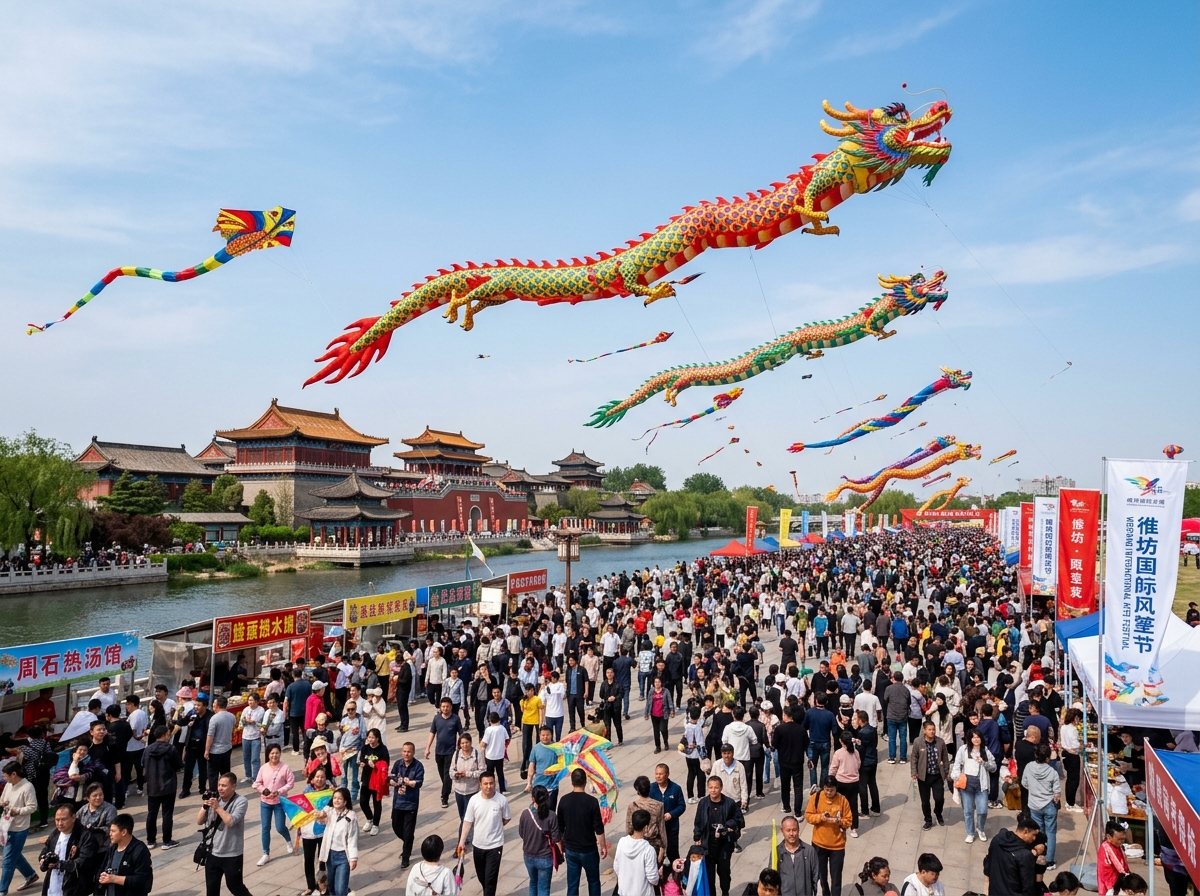
Located in China’s Shandong Province, Weifang is officially recognized as the “Kite Capital of the World.” This isn’t just a title; the city produces over 2 million kites every single year. The Weifang International Kite Festival 2026: Dates & Program will likely see teams from over 60 countries.
What makes Weifang unique is the sheer scale and variety. You will see 30-meter-long dragon kites with articulating heads and “soft” kites shaped like giant whales or modern superheroes. In 2024, the festival even broke records with a simultaneous launch of over 10,000 kites! For a solo traveler, the workshops are a highlight—you can learn from master craftsmen who have been refining their techniques for generations.
Bali: Where Spirituality Meets the Sky
In Bali, kite flying is a sacred duty. The Bali Kite Festival is a seasonal religious event held during the windy months (usually July) to send a message of thanks to the Hindu gods for abundant crops.
The scale here is jaw-dropping. We’ve seen kites that are 4 meters wide and 10 meters long, with “Janggan” (bird-shaped) kites sporting tails that exceed 100 meters in length! These giants require a “Banjar” (village team) of 70 to 80 people to launch. Each team arrives at Padanggalak Beach with their own Gamelan orchestra, creating a rhythmic, trance-like atmosphere as the kites take flight. If you are in the Travel Planning phase, Bali offers a perfect blend of beach relaxation and intense cultural immersion.
Competitive Spirit: Battles and Giant Creations
While some festivals are about beauty, others are about “aerial combat.” This competitive edge is a core part of cultural kite festivals Asia.
The Ikazaki Kite Battle
In Japan, the Ikazaki Kite Battle festival – UCHIKOGENIC is a 400-year-old tradition held on Children’s Day (May 5th). Here, the goal is to use Gagari—razor-sharp metal blades attached to the kite strings—to cut down opponents. It is a “heroic battle” where 500 huge kites soar and clash over the Toyoaki-gawara riverbank.
One of the most touching elements for us is the Shusse kite. These giant kites have the names of newborn babies written on them, flown high to wish the children health and future success. It’s a beautiful mix of fierce competition and tender family tradition.
Engineering Marvels: The Nagaraja Kite
To see the pinnacle of kite engineering, look to the Nagaraja kite in Bali. This behemoth weighs a staggering 707 kg and requires a crew of 200 people and four trucks just to transport and fly. Seeing a 250-meter-long dragon-serpent take to the air is a reminder that in these cultures, the “sky is the limit” is taken quite literally.
Unique Designs in Cultural Kite Festivals Asia
Every region has its “signature” kite:
- Wau-balang (Malaysia): Crescent-shaped kites known for their intricate floral patterns.
- Rokkaku (Japan): Hexagonal fighter kites that are surprisingly stable and powerful.
- Bebean (Bali): Fish-shaped kites that dance through the air with a distinct “humming” sound created by a vibrating ribbon called a guwangan.
- Tukkal (India): Box-shaped lanterns that turn the night sky into a glowing tapestry.
For solo travelers interested in the arts, these festivals are like visiting an outdoor museum. You can find more inspiration for your next trip in our Destinations section.
Practical Tips for Solo Travelers Attending Asian Kite Festivals
Navigating these massive events can be overwhelming if you aren’t prepared. Here is our guide to staying safe and having the best experience.
| Tip | Description |
|---|---|
| Safety First | Be extremely careful of kite strings. In India and Japan, strings are often coated in glass or have blades. Never try to catch a falling kite with your bare hands. |
| Sun Protection | You will be looking up at the sky for hours. High-SPF sunscreen, a wide-brimmed hat, and polarized sunglasses are non-negotiable. |
| Transport | Festivals like Ikazaki offer free shuttle buses from the nearest train station (Uchiko). In Ahmedabad, the traffic can be gridlocked; walking or using local rickshaws is often faster. |
| Booking | For the Weifang or Ahmedabad festivals, book your accommodation at least 3-4 months in advance. These cities fill up completely. |
| Etiquette | Always ask before joining a team on a rooftop or beach. Most people are incredibly welcoming and will even offer you food or a turn at the reel! |
Frequently Asked Questions about Asian Kite Festivals
When is the best time to visit kite festivals in Asia?
It depends on the wind! January is the peak for India (Uttarayan). April is the best time for China (Weifang). May is the season for Japan’s Children’s Day battles, and July through August offers the best trade winds for Bali’s spectacular displays.
Are these festivals safe for solo international travelers?
Yes, but you must be “crowd-aware.” These events attract millions of people. Keep your belongings secure in a front-facing bag and stick to designated viewing zones if you aren’t comfortable in thick crowds. In Gujarat, the biggest danger is the manja thread; stay away from the “line of fire” to avoid cuts.
What are the most famous kite shapes in Asian culture?
The Chinese Dragon is the most iconic, symbolizing power. The Balinese Janggan (bird/dragon) represents a connection to the divine. The Japanese Rokkaku (hexagon) is famous for its stability in battle, and the Indian Patang (rhombus) is the gold standard for agility in fighter competitions.
Conclusion
The cultural kite festivals Asia hosts are a testament to the region’s ability to preserve ancient traditions while embracing the modern world. From the 400-year-old battles in Japan to the record-breaking mass launches in China, these events offer a level of cultural immersion that is hard to find anywhere else.
At PrimeFinHub, we believe that travel should be about more than just seeing sights; it should be about experiencing the soul of a place. Whether you are standing on a rooftop in Ahmedabad or a beach in Sanur, looking up at a sky filled with color reminds us that we all share the same horizon.
Are you ready to plan your independent exploration of these incredible spectacles? Visit https://www.primefinhub.com/ for more guides on immersive cultural travel and start your journey toward the clouds today!
