
The Quiet Pull of the Sea: Why Traditional Fishing Solo Villages Are the Ultimate Independent Traveler’s Destination
Traditional fishing solo villages are some of the most rewarding destinations on earth for independent travelers seeking real cultural immersion.
Here’s a quick look at the best options and what makes each one worth visiting:
| Village | Country | Standout Feature | Best For |
|---|---|---|---|
| Cai Beo | Vietnam | 7,000-year history, floating houses | History lovers |
| Vung Vieng | Vietnam | Bamboo boats, pearl farms, limestone cliffs | Slow travel |
| Marsaxlokk | Malta | Colorful luzzu boats, Sunday fish market | Culture + food |
| Canh Duong | Vietnam | Traditional hand-line needlefish fishing | Fishing enthusiasts |
| Kikhavn | Denmark | 13th-century car-free hamlet | Peaceful exploration |
| Rukha Valley | Bhutan | Olep smoked fish (Nya Dosem) tradition | Off-the-beaten-path |
| Ha Lien | Vietnam | Water-surrounded village, mangrove life | Authentic daily life |
There’s something different about arriving at a place where the sea isn’t just scenery. In these villages, fishing isn’t a hobby — it’s everything. It shapes the food, the language, the daily rhythm, and the architecture.
Solo travelers are uniquely positioned to experience this. Without a group itinerary to stick to, you can wake up at dawn with a local fisherman, drift through floating fish cages on a bamboo boat, or simply sit at a harbor and watch a way of life that has barely changed in centuries.
These aren’t resorts. They aren’t tour packages. They’re living communities — some dating back thousands of years — where the welcome is genuine and the stories run deep.
This guide covers the world’s most compelling traditional fishing villages for solo explorers: where they are, how to reach them, what to do, and how to visit responsibly.
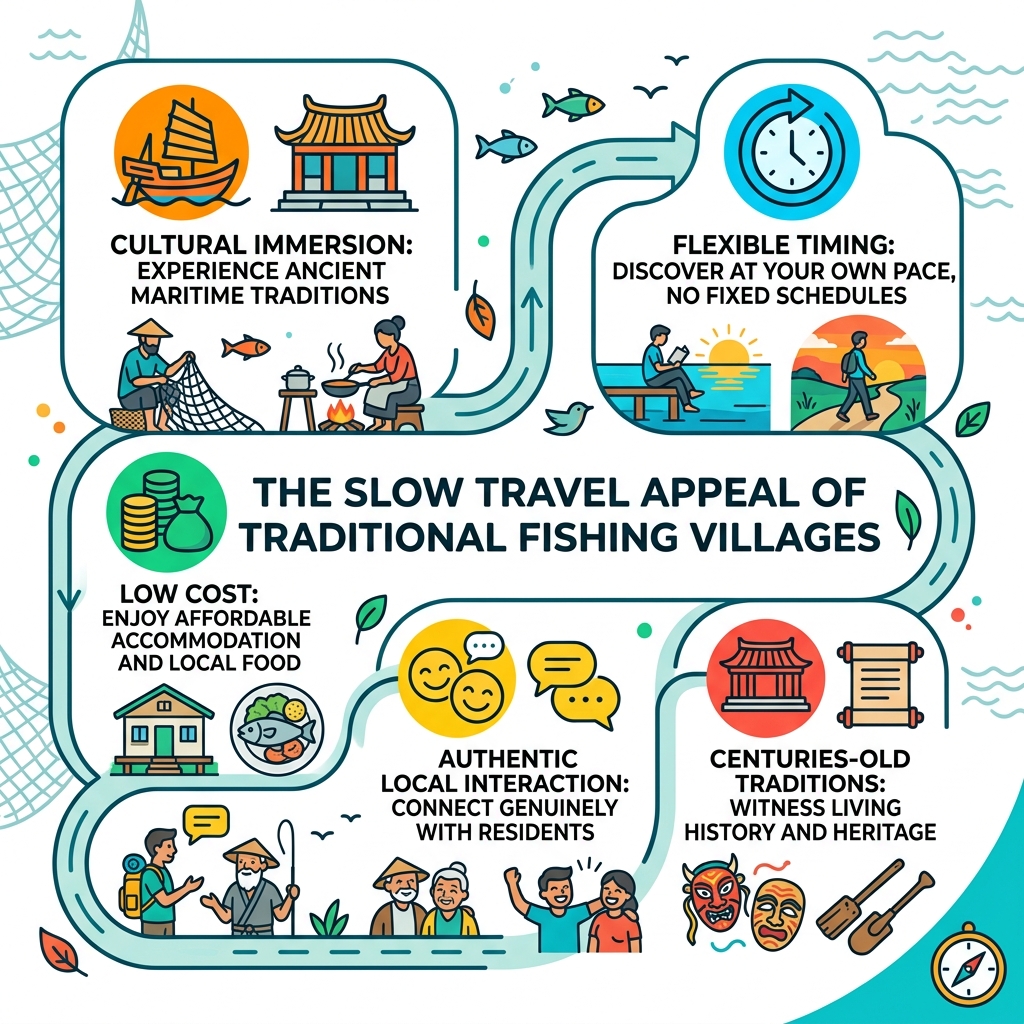
Defining the Authenticity of Traditional Fishing Solo Villages
When we talk about traditional fishing solo villages, we aren’t referring to modern ports with industrial trawlers. We are talking about “living museums”—places where the maritime lifestyle has been preserved through sheer resilience and geographic isolation. These villages maintain their unique character by sticking to ancestral techniques and communal living structures that prioritize the sea’s health over mass production.
Take Cai Beo Fishing Village in Vietnam’s Lan Ha Bay. This isn’t just a collection of floating houses; it is one of the oldest prehistoric sites in Southeast Asia. Archaeological findings here have revealed a human presence dating back between 4,000 and 7,000 years. Imagine standing on a floating deck knowing that beneath the 4-meter-deep waters, researchers found 137 stone tools, 1,424 ceramic shards, and 568 animal bones. For the solo traveler, this depth of history provides a profound sense of connection to the “cradle” of ancient maritime culture.
Authenticity is also found in the physical layout of these settlements. In places like Life in Ha Lien: A village surrounded by water for over three centuries, the village operates like a floating oasis. Established in 1653, Ha Lien is accessible only by a narrow 1-km concrete road or by boat. Because it is surrounded by the Nha Phu Lagoon and protected by thick mangrove forests, the 1,200 residents have maintained a lifestyle that resists the frantic pace of modern urbanization. Walking through 3-meter-wide alleys where three generations live under one roof isn’t a “tourist experience”—it’s a privilege.
Top Global Destinations for Independent Anglers and Culture Seekers
For those of us who travel solo, the goal is often to find a balance between accessibility and untouched charm. The following destinations offer exactly that.
The Mediterranean Charm of Marsaxlokk
In the southeastern corner of Malta lies Marsaxlokk, a village that feels like a Technicolor dream. It is home to just over 3,500 people and is famous for its vibrant harbor filled with traditional luzzu boats.

These boats are more than just pretty; they carry the “Eye of Osiris” on their bows—an ancient Phoenician symbol meant to protect fishermen from evil at sea. For a solo traveler, a Sunday visit to the fish market is a sensory explosion. You can grab a window seat on the local #85 bus from Valletta, watch the limestone landscapes roll by, and spend the afternoon eating fresh ftira bread and bruschetta at a converted fisherman’s house. It’s the perfect blend of solo-friendly infrastructure and authentic local character.
The Historic Quiet of Kikhavn
If you prefer the crisp air of the North Sea, Kikhavn in Denmark is a must-visit. Dating back to the 13th century, this is the oldest fishing settlement in the Halsnæs region. What makes it a “solo-friendly” gem is its car-free policy. By banning vehicles within the village, Kikhavn has preserved a peaceful, child-friendly atmosphere where the only sounds are the wind and the waves.
As we explore Kikhavn – Halsnæs’ Oldest and Most Idyllic Fishing Village, we see a landscape of thatched-roof farms and narrow winding streets that haven’t changed in 200 years. It’s a place for slow walks along the North Coast Path and reflective moments at the Spodsbjerg Lighthouse.
The Smoked Traditions of North Holland
The Netherlands offers a different kind of maritime history. In North Holland, villages like Monnickendam and Enkhuizen (nicknamed “Herring City”) tell the story of the former Zuiderzee. A solo cycling trip here is highly recommended. You can visit the Zuiderzee Museum, which features over 140 historic buildings, or stop at local smokehouses like “De Boer Brothers” to taste smoked mackerel or eel. There is a simple rule here: the farther you go from Amsterdam, the more authentic the fish tastes.
Vietnam’s Floating Wonders: Traditional Fishing Solo Villages of the East
Vietnam is arguably the world capital of the floating village. For independent explorers, these communities offer a level of immersion that is hard to find elsewhere.
- Cai Beo: Located 1.5 km from Cat Ba town, this village consists of about 400 households living on floating platforms. You can rent a small motorboat for a few dollars and weave through the fish cages where locals raise high-value species.
- Vung Vieng: Tucked away in Bai Tu Long Bay, Beloved Vung Vieng fishing village is often described as one of the most beautiful in the world. It features a unique “village gate”—a giant natural stone arch—and a “community raft” that serves as the village square. It’s an ideal spot for solo kayaking, allowing you to drift past pearl farms and limestone cliffs at your own pace.
- Ha Lien: This village specializes in “sea pig tails” (a local brackish water delicacy). It’s a place where you can see 92-year-old residents who remember trading seafood for rice on foot, sitting alongside 20-somethings sorting the day’s catch.
The Hidden Smoked Fish Traditions of Bhutanese Solo Villages
Perhaps the most remote entry on our list is the Rukha Valley in Bhutan. Here, the Olep people—a former hunter-gatherer group—maintain a tradition known as Nya Dosem (smoked fish).
Living in the Harachhu River ecosystem, the Oleps have transitioned from nomadic life to settled fishing, but they’ve kept their ancestral techniques. As detailed in In Bhutan, hunter-gatherer Oleps bank on smoked fish tradition to sustain way of life, this community of only 20 households relies on the Harachhu River’s snowtrout.
For a solo traveler, visiting Rukha is a deep dive into cultural resilience. You’ll see how they manage resources through the Harachhu Captured Fisheries Management Group, ensuring that their fishing—which sometimes contradicts strict Buddhist principles of non-violence—is done with the utmost respect and sustainability.
Mastering the Craft: Traditional Methods and Sustainable Livelihoods
What defines traditional fishing solo villages is the refusal to use destructive modern methods. Instead, these communities rely on techniques that require immense skill and patience.
In Canh Duong, a 380-year-old village in Vietnam, the specialty is needlefish (hairtail). Unlike the massive nets used by commercial fleets, Needlefish fishing in Canh Duong fishing village involves 18-meter bamboo rods and 200-meter hand lines. Fishermen head offshore for half a month at a time, managing their own catch and profits.
Selective vs. Commercial Fishing: A Comparison
| Feature | Traditional Hand-Lining | Commercial Net Fishing |
|---|---|---|
| Targeting | Selective (only large fish) | Mass catch (includes juveniles) |
| Environmental Impact | Minimal | High (habitat destruction) |
| Skill Required | Years of apprenticeship | Mechanical operation |
| Sustainability | High (allows regeneration) | Low (depletes stocks) |
In Bhutan, the Oleps use traditional traps called dho and dhang. These traps are designed with 1-meter gaps and 3-inch eyeholes specifically to allow immature fish to escape. This isn’t just “tradition”; it’s sophisticated environmental management that ensures the river will still provide for the next generation.
Practical Guide for the Solo Explorer: Safety, Timing, and Etiquette
Visiting these remote corners of the world requires a bit more planning than a standard city break. Here is how we recommend navigating your journey.
Timing and Weather
Because fishing is often dictated by tides and seasons rather than a clock, flexibility is your best friend.
- Vietnam: Visit the North (Cai Beo, Vung Vieng) from September to December for the clearest skies. For the South (Phu Quoc), November to April is ideal.
- Malta: Spring and Autumn offer the best weather for Marsaxlokk without the summer heat.
- Denmark: Summer (June-August) is when Kikhavn truly shines, as the population swells with visitors enjoying the long Nordic days.
Solo Safety and Logistics
- Boat Safety: When hiring a private motorboat in a floating village, always check for life jackets and a working motor. In Vietnam, it is a “pro tip” to agree on the price and duration in writing to avoid any confusion with “Vietnamese time.”
- Navigation: If you’re heading to a harbor for a sunrise market, bring a torch (flashlight) for dark piers and wear shoes with excellent grip.
- Communication: In remote areas like Rukha, only a few elders may speak the original Oleykha dialect. Learning a few basic phrases in the national language (like Dzongkha in Bhutan or Vietnamese) goes a long way.
Cultural Etiquette
As solo travelers, we are ambassadors for the independent travel community.
- Ask Before You Snap: Always ask permission before taking photos of people, especially in their homes or places of worship.
- Gifting: In Vietnamese floating villages, it is common to offer a small gift (around VND 100,000 or $4) when visiting a household.
- Dress Modestly: Even in coastal towns, modest dress is appreciated when you move away from the beach and into the residential heart of the village.
Preserving the Catch: Challenges and Sustainability in Coastal Communities
The very things that make traditional fishing solo villages so special—their isolation and adherence to old ways—also make them vulnerable. These communities face significant modern challenges:
- Climate Change: In Bhutan, shrinking glaciers and extreme weather events (52 events between 2019-2024) threaten the Harachhu River’s water temperature and fish populations.
- Modernization: In Vietnam, the younger generation is increasingly moving to cities for higher-paying jobs, leaving the 380-year-old traditions of villages like Canh Duong at risk.
- Environmental Degradation: Overfishing by large commercial vessels near traditional waters and the influx of plastic waste are constant battles.
How can we help? We can contribute to the sustainability of these villages by practicing responsible tourism. This means staying in local homestays instead of large hotels, hiring village guides, and refusing to consume protected or undersized seafood. Every dollar spent directly in the community helps prove that their heritage is economically valuable.
Frequently Asked Questions about Traditional Fishing Villages
What is the best time of year to visit these villages?
It depends on the region. For Southeast Asian floating villages, the dry season (typically October to April) is best. For European villages like Kikhavn or Marsaxlokk, the warmer months from May to September offer the most vibrant local life and easiest transportation.
How can solo travelers reach remote floating communities safely?
The best way is to use local transport to the nearest hub (like Cat Ba town or Valletta) and then hire a licensed local boatman. For very remote areas, we recommend booking a specialized tour through an agency that focuses on cultural immersion rather than mass tourism.
What are the most respectful ways to interact with local fishermen?
Show genuine interest in their craft. If you see someone mending a net or preparing a line, a simple nod and a smile go a long way. If you want to join a fishing trip, ask through your homestay host or a local guide to ensure it is done ethically and safely.
Conclusion
Exploring traditional fishing solo villages is about more than just seeing new places; it’s about witnessing the enduring bond between humanity and the sea. Whether you are watching the sunrise over the 7,000-year-old history of Cai Beo or tasting the ancient Nya Dosem in the mountains of Bhutan, these experiences stay with you long after you’ve returned home.
At PrimeFinHub, we believe that the best travel happens when you step away from the crowds and into the heart of a community. We specialize in identifying Cultural travel destinations for solo travelers that offer this exact level of depth and authenticity.
Ready to cast your line into a new adventure? Start planning your next independent journey today and discover the world’s most immersive cultural spots for yourself.
